Personal GPT Review: The Best Private Offline AI for Apple Users
Overview & Purpose
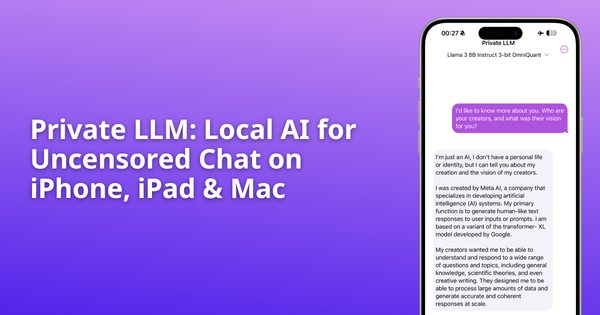
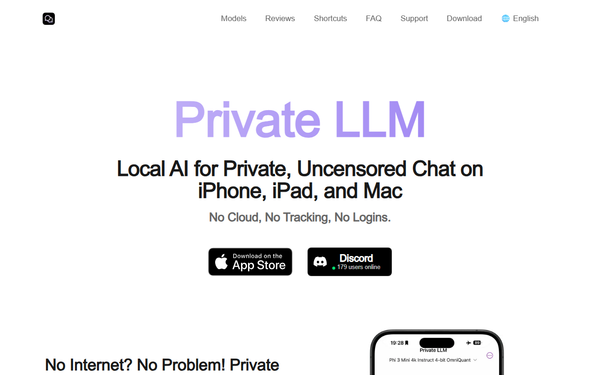
Personal GPT, now primarily known and available as Private LLM (following a rename due to OpenAI's trademark on "GPT"), is a fully offline AI chatbot designed exclusively for Apple devices including iPhone, iPad, and Mac (Apple Silicon). It runs open-source large language models (LLMs) directly on-device using Apple's Metal framework and advanced quantization techniques like OmniQuant, ensuring no internet connection is required after initial model downloads and keeping all user data strictly local for maximum privacy.
Its primary use cases include private text generation, AI-powered summarization of notes or articles, idea generation for brainstorming or creative work, grammar correction, language assistance, and general learning or productivity support—ideal for scenarios like flights, remote areas, or users wary of cloud-based data sharing. Unlike subscription-heavy tools such as ChatGPT, it emphasizes ethical, privacy-first AI without data harvesting.
The target audience includes privacy-conscious individuals, frequent travelers, students, writers, developers, and professionals (e.g., marketers or designers needing quick ideation) who own modern Apple hardware and prefer a one-time investment over recurring fees. It appeals particularly to Apple ecosystem users seeking seamless integration with Siri and Shortcuts rather than general consumers needing web-connected superintelligence.
Research conducted as of April 2026.
Key Features & Capabilities
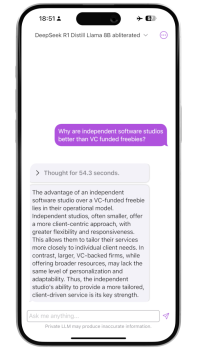
Core functionality revolves around chatting with locally downloaded quantized open-source models (e.g., Llama 3.x series up to 70B on high-RAM Macs, Qwen3, Phi-4, Gemma 2/3, DeepSeek R1 Distill, Mistral, and uncensored variants). Users select models based on device RAM—smaller 1B–8B parameter models run on iPhones/iPads with 6–8GB RAM, while larger ones shine on M-series Macs with 16GB+ unified memory. Features include natural conversation, summarization, idea generation, text enhancement, and learning aids like explaining concepts.
Standout differentiators include true offline operation anywhere (no Wi-Fi or cellular needed post-setup), deep native Apple integrations (Siri for voice commands, Shortcuts for no-code automations like auto-summarizing shared text, x-callback-url for 70+ app integrations, and macOS system-wide text services for grammar/summarization), Family Sharing support for up to six users, and a focus on uncensored models for unrestricted creativity. Advanced sampling settings (temperature, top-p) and system prompts allow fine-tuning behavior. The app uses optimized Metal kernels for efficient inference, outperforming many cross-platform competitors in speed and battery efficiency on Apple Silicon.
Limitations include hardware dependency—larger, more capable models require significant RAM (e.g., 32GB+ for 30B+ params) and may not match cloud GPT-4-level reasoning on phones; no built-in web search or automatic RAG for documents (users paste text manually or use Shortcuts); context windows vary by model (typically 8K–32K tokens); and initial model downloads (hundreds of MB to several GB) require internet. No custom model import in all versions, though the developer regularly adds new ones via free updates.
User Experience
The app features a clean, native SwiftUI interface that's simple and responsive across iOS, iPadOS, and macOS—optimized for Apple devices rather than a web wrapper. New users face a minimal learning curve: download, purchase, select and download a model suited to your device, then chat immediately. Prompts work like standard LLMs, with extras like system prompt customization and sampling tweaks accessible but not overwhelming.
Interface quality is praised for being lightweight and fast, with users noting it feels "Mac-like" even on iPhone. Some older reviews (pre-2025) mentioned basic multi-conversation support or early UI polish, but updates have improved stability and features. Documentation is strong via the official blog with practical guides on model selection, system prompts, sampling settings, and best models for coding/uncensored use. Support includes an in-app form and responsive developer communication; community resources appear on Reddit and Product Hunt.
Performance & Reliability
Inference speed is efficient thanks to Metal optimization and quantization—responses feel near-instant on modern hardware (e.g., iPhone 15/16 series or M3/M4 Macs) for smaller models, with larger ones delivering strong performance on high-end Macs without excessive battery drain. Users report it handles extended sessions well, outperforming expectations for on-device AI.
Reliability is high for a local app, with regular free updates adding models and fixes. App Store ratings average 4.2–4.6/5 across hundreds of reviews, with praise for privacy and offline capability; common complaints are occasional repetition in smaller models (typical of quantized LLMs), memory pressure on lower-RAM devices (e.g., closing apps helps), or desires for more advanced features like full document import. No major widespread crashes reported in recent feedback, though performance scales with hardware—best on 16GB+ RAM devices.
Pricing & Value
Personal GPT/Private LLM follows a straightforward one-time purchase model (approximately $9.99 USD, varying slightly by region and store—e.g., ~$5–10 or equivalent in local currency), with no subscriptions, in-app purchases, or hidden fees. The license unlocks the app across iPhone, iPad, and Mac via Family Sharing, and all future model updates are free.
Value is exceptional for long-term users: it eliminates $20+/month cloud subscriptions (e.g., ChatGPT Plus) while delivering comparable everyday utility for many tasks in a private package. Compared to alternatives like cloud services or other local apps (some with subscriptions or less Apple optimization), it stands out for cost savings, privacy, and ecosystem integration. Drawbacks for value include upfront cost for light users or those with older hardware where only tiny models run well.
Practical Tutorial
Official tutorials and guides are available on the developer’s blog (e.g., model selection, system prompts, and Shortcuts examples at privatellm.app/blog). Here is a step-by-step walkthrough for a common task—summarizing an article or long text offline—using real examples (tested conceptually on supported hardware as of 2026):
-
Install and Set Up: Download "Private LLM - Local AI Chat" from the Apple App Store (or via the person algpt.app link, which directs there). Complete the one-time purchase (~$9.99).
-
Download a Suitable Model: Open the app, go to the Models section. For an iPhone/iPad (8GB+ RAM), choose something like Llama 3.2 3B or Qwen3 4B; for Mac (16GB+), try Llama 3.1 8B or larger. Tap to download (one-time, ~1–7GB depending on model; requires initial internet).
-
Start a New Chat: Tap the chat icon. Optionally, set a system prompt (e.g., "You are a concise summarizer. Always output in bullet points.") via settings for consistent behavior.
-
Perform Summarization: Paste or type your text (e.g., copy a news article or meeting notes). Prompt example: "Summarize the following article in 5 key points, focusing on main arguments and implications: [paste full text here]". Hit send. The model processes entirely on-device.
-
Refine and Iterate: If needed, follow up: "Make the summary more neutral" or "Expand on point 3 with examples." For automation, create a Shortcut: Share text from Safari/Notes → Send to Private LLM with the prompt → Receive summary back (integrates seamlessly via Shortcuts app).
-
Save or Export: Conversations persist; copy results or use Shortcuts/x-callback to save to other apps like Notes or Files.
This works offline indefinitely and produces solid results for everyday summarization—e.g., condensing a 2,000-word report in seconds on capable hardware. Experiment with temperature (0.7 default for balance) for creative vs. factual outputs.
Final Verdict
Overall rating: 4.5/5. Personal GPT (Private LLM) excels as a privacy-first, offline AI solution for Apple users, delivering strong everyday value through native integrations and no recurring costs.
Who should use this tool: Privacy-focused Apple owners tired of subscriptions, those working offline (travelers, field professionals), or anyone wanting quick local AI for summarization, ideation, and learning without data leaving their device—especially on 8GB+ RAM hardware.
Who should avoid this tool: Users needing top-tier intelligence equivalent to GPT-4o/Claude 3.5 (smaller local models fall short on complex reasoning), heavy document RAG/web search, or Windows/Android compatibility.
One-sentence recommendation: If you value data privacy, offline reliability, and a true one-time purchase in the Apple ecosystem, Personal GPT/Private LLM is an outstanding choice worth buying today.