Platus Review: Automate Legal Workflows and Online Notarization

Overview & Purpose
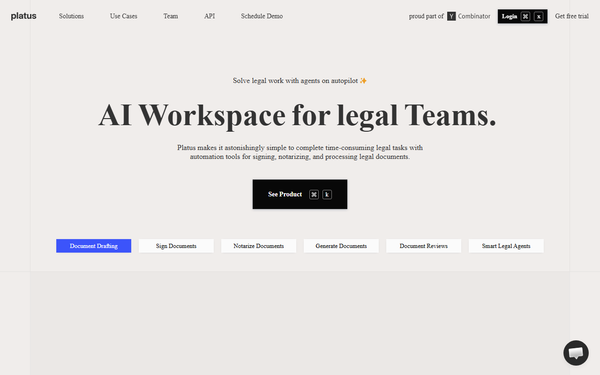
Platus (platus.com) is an AI-powered legal infrastructure platform designed to automate and streamline operational legal processes for businesses. It serves as a comprehensive workspace where legal teams can draft, review, sign, notarize, and process documents efficiently using AI agents, no-code workflows, and a robust API. Launched as part of Y Combinator's F24 batch, it positions itself as the 'first Notary-as-a-Service API,' enabling instant online notarization alongside e-signatures and intelligent document handling.
Primary use cases include automating high-volume tasks like generating NDAs and powers of attorney (POAs), managing contract approvals, compliance workflows (including KYC elements), and scaling document notarization for real estate, investor agreements, or corporate operations. It helps businesses reduce legal operations time significantly, allowing focus on core activities while ensuring compliance.
Target audience primarily includes legal teams at fast-growing startups, mid-sized enterprises, and law firms. Developers can leverage the API for custom integrations into business applications. It's particularly suited for SMEs seeking affordable, fast alternatives to traditional legal services rather than general consumers or pure marketers/designers.
Key Features & Capabilities
Core functionality revolves around an end-to-end document lifecycle: AI-driven drafting and generation (e.g., NDA Contract Generator, Contract Filler with smart variable detection), AI review and approval (AI Lawyer performing extensive checks with human-in-the-loop flows), e-signature requests, online notarization, and customizable automation workflows.
Standout features differentiating it from competitors like DocuSign or basic remote notary services include the integrated Notary-as-a-Service API for high-volume processing (ideal for thousands of POAs or Apostilles), personalized smart legal agents that act as AI paralegals, a chat assistant backed by your company's knowledge base, templates, and cases, and no-code playbooks combined with API flexibility. It supports use cases in real estate, compliance, and contract management, claiming to reduce legal operations by up to 2x and save significant time (e.g., 22 hours faster contract closure).
Limitations include its early-stage nature (founded 2024), potentially limited third-party integrations compared to more mature platforms, and reliance on jurisdiction-specific notarization validity (strong in EU/Germany via its Beglaubigt.de roots). It is not a substitute for licensed legal advice and requires human oversight for critical matters. Missing features might include advanced analytics dashboards or extensive global notary networks, though these could be in development.

User Experience
Platus emphasizes ease of use with a no-code interface accessible to non-technical legal professionals, alongside powerful API options for developers. The learning curve is relatively low thanks to the intuitive chat assistant and drag-and-drop workflows, though mastering custom agents and complex playbooks may take some time for advanced users.
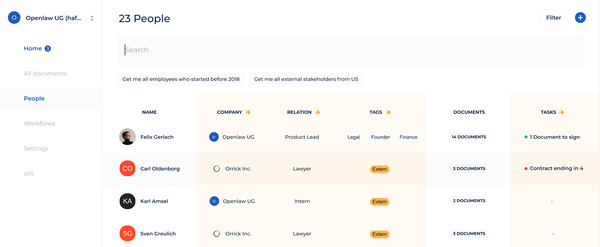
The interface is described as a modern AI workspace, clean and focused on productivity with features like file uploads, automated filling, and approval tracking. Documentation includes API references (available at platus.mintlify.app for notarization services), with support resources likely including direct founder outreach, demo bookings, and in-app guidance given its startup status. Public tutorials are limited, but the platform's design promotes quick onboarding.
Performance & Reliability
The platform delivers on speed promises, with notarizations often completed within 1-24 hours and AI processing enabling rapid document handling at scale. Efficiency gains are highlighted in case studies and testimonials, such as automated investor agreement filling for 50+ parties.
Reliability is supported by GDPR compliance, encryption standards, and servers in Europe. Human approval steps add a layer of safety for legal documents. As a newer entrant (research as of March 2026), there are few widespread user reports of issues or downtime; launch feedback on Product Hunt and YC has been positive without notable complaints. Potential concerns for any AI legal tool include occasional inaccuracies requiring verification, which Platus mitigates with review tools.
Pricing & Value
Pricing details are not publicly listed in detail on the website, suggesting a custom or contact-sales model typical for B2B legal tech, with indications of a freemium approach or free tier for basic use and paid plans for API access, higher volumes, and advanced features (per secondary sources). Enterprise options are likely available for larger teams or high-scale needs.
The value proposition is strong for SMEs and startups: by bundling AI intelligence, e-sign, and notarization into one platform, it can substantially lower costs compared to hiring additional paralegals or using multiple disparate tools. Alternatives like traditional notaries or standalone e-signature platforms may be slower and more expensive for repetitive tasks. ROI comes from time savings and scalability, making it a cost-effective choice for growing businesses.
Practical Tutorial
Official in-depth tutorials are emerging, but based on platform capabilities described on platus.com and related docs, here's a step-by-step walkthrough for a common task: Automating the creation, signing, and notarization of an NDA for a new investor or partner.
-
Sign Up and Setup: Create an account at platus.com or app.platus.com. Upload your company's standard templates, knowledge base documents, and define key data fields (e.g., party names, dates) for AI automation.
-
Generate or Select Document: Use the AI chat assistant or dedicated NDA Contract Generator to create a new document or load a pre-approved template. Prompt the AI with specifics like "Generate an NDA for [Partner Name] with standard clauses for tech startup."
-
AI Filling and Review: Utilize the Contract Filler (AI Fill) feature to automatically populate variables from stored data or inputs. Then, route it through the AI Contract Approver for an initial review (leveraging 120+ AI checks for compliance and issues).
-
Set Up Workflow: In the no-code workflow builder, add steps for internal approvals, e-signature requests via email or links, and notarization. Define playbooks for repeatable processes.
-
Collect Signatures and Notarize: Send signature requests. Once signed, trigger the online notarization process directly in the platform or via API call. For high-volume, use the Notarization API to process multiple documents programmatically.
-
Monitor and Complete: Track progress in the dashboard. Receive the finalized, notarized document via email or download, with all audit trails for compliance.
For API integration (developers): Authenticate and use endpoints to submit documents, manage signers, and initiate notarization (see https://platus.mintlify.app/ for Beglaubigt API details). Test in sandbox if available. For video demos or more, book via the website or check founder posts on LinkedIn/Product Hunt.
Final Verdict
Overall rating: 4.2 out of 5. Platus excels in innovation and automation potential but is still maturing with limited public reviews and pricing transparency.
Summary of who should use this tool and why: Legal operations teams in startups and SMEs should use Platus to dramatically speed up routine legal tasks, reduce costs through AI and automation, and handle notarizations at scale without traditional bottlenecks—perfect for those prioritizing efficiency and compliance in growth phases.
Summary of who should avoid this tool and why: Large enterprises with established legal departments or those requiring highly specialized jurisdiction coverage beyond current strengths (primarily EU-focused) may prefer more mature, enterprise-grade alternatives with broader support. Also, avoid if you need full legal representation rather than infrastructure tools.
One-sentence recommendation: Platus represents a smart, AI-driven leap for businesses tired of slow legal processes, offering integrated notarization and automation that's worth trying for any scaling team.
Sources: Official site platus.com, Y Combinator company page, Product Hunt launch, founder LinkedIn and Munich Startup coverage. Note: Information current as of March 2026 research; verify latest on site as features evolve rapidly.