Podfy AI Review: Automate Podcast Marketing and Repurposing
Overview & Purpose
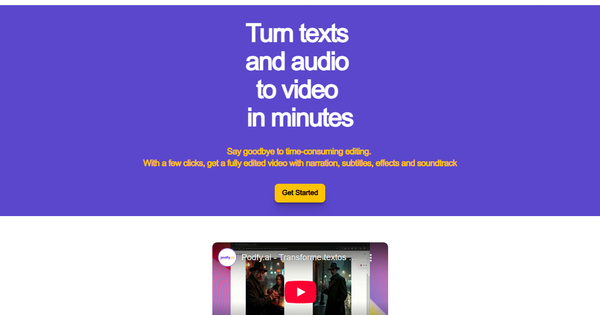
Podfy AI is an AI-powered podcasting platform that automates post-production and marketing tasks by generating transcripts, show notes, timestamps, tweets, quotes, newsletters, social media posts, catchy titles, and episode summaries from a single input source. Users simply provide an RSS feed, YouTube channel link, or audio file (MP3/WAV), and the tool processes the episode to create a full suite of assets in minutes. Its primary use cases include streamlining episode repurposing for SEO, promotion across social channels, accessibility improvements, and global reach through multilingual support.
Target audience encompasses independent podcasters, content marketers, podcast producers, marketing agencies, SEO specialists, social media managers, freelance writers, and educational creators who need to save time on repetitive tasks while expanding audience engagement. It is particularly suited for time-constrained professionals and multilingual podcasters aiming to make episodes more discoverable and shareable.
Key Features & Capabilities
Core functionality revolves around one-click AI generation: users input an episode via RSS feed, YouTube channel, or direct audio upload, and the system instantly produces transcripts, show notes, timestamps (for easy navigation), catchy titles, quotes, links and mentions, social media posts/tweets, newsletters, and topic summaries. Additional capabilities include support for over 30 languages, automatic identification of key segments, and direct integration with podcast platforms for seamless publishing.
Standout features that differentiate it from competitors include the all-in-one single-click workflow (no need for multiple tools or manual uploads), built-in AI fine-tuning to adjust tone, switch between direct/indirect speech, correct spelling, or customize style, and the ability to generate unique content variations with every click for fresh promotional assets. These elements go beyond basic transcription services by delivering ready-to-use marketing and SEO materials tailored for cross-platform distribution.
Limitations include the absence of a dedicated mobile app, advanced analytics or guest identification tools, offline processing, and deep custom integrations. Some directory listings note that editing depth is solid for fine-tuning but may not replace professional studio software for highly complex productions. No enterprise-level features (such as team collaboration or custom APIs) are prominently listed.
User Experience
Podfy AI boasts an intuitive and user-friendly interface that requires minimal technical knowledge, resulting in a very low learning curve—ideal for non-technical podcasters. The dashboard allows quick selection of input sources and one-click generation, with built-in editing panels for real-time fine-tuning of outputs. Navigation feels straightforward, focusing on speed rather than overwhelming options.
Documentation and support resources are light: the official site links to basic FAQs covering functionality, language support, file formats, and editing capabilities, while directory pages provide additional how-it-works overviews. No extensive public knowledge base, video library, or community forum was identified; support appears to be handled via in-app channels or email (typical for early-stage AI tools). Overall, the emphasis is on simplicity, making it accessible for beginners while still powerful for regular users.
Performance & Reliability
Generation speed is a highlight, with most assets produced in minutes even for full-length episodes, making it highly efficient for weekly or batch workflows. Reliability stems from consistent AI processing of standard inputs (RSS, YouTube, audio files) and multilingual accuracy claims. No widespread outages or major technical complaints appear in available sources as of the research date.
Known issues or common complaints are minimal due to limited public user feedback—zero detailed reviews on major platforms like G2 or Reddit, and only sparse mentions elsewhere. Potential AI-specific risks (such as occasional transcription inaccuracies in accents or complex topics) are not widely reported but align with general limitations of similar tools. Overall performance is described as dependable for its core repurposing tasks.
Pricing & Value
Podfy AI follows a freemium model with a free tier for testing (limited episodes or basic outputs) and paid plans starting at $7 per month. No detailed tier breakdowns or enterprise options are publicly specified on directory sites, though higher plans presumably unlock unlimited generations or advanced features. Annual billing discounts are not explicitly confirmed.
The value proposition is strong for cost-conscious users: it delivers significant time savings compared to manual transcription services or fragmented tools like Descript or Otter.ai (which often cost $12–$24+ monthly with narrower scopes). At the entry paid level, the comprehensive output suite (transcripts through full marketing packages) offers excellent ROI for indie creators or small agencies, though those needing premium support or analytics may find competitors more feature-rich at similar prices.
Practical Tutorial
No official video tutorials or step-by-step guides were located on the site or in public searches; the following walkthrough is based on the consistently described workflow across trusted directories and can be replicated directly on podfyai.com.
- Sign up or log in for free at podfyai.com (email or social login required).
- On the dashboard, choose your input: paste a YouTube channel/episode URL, enter an RSS feed URL, or upload an MP3/WAV audio file.
- Click “Generate” to process the episode. Select desired outputs (e.g., full transcript + show notes + timestamps + tweets + newsletter + quotes).
- Review results in the editor: fine-tune tone (professional/casual), speech style (direct/indirect), spelling corrections, or language translation if needed.
- Export or copy assets individually or as a bundle—download transcripts for SEO, schedule tweets, or paste show notes directly into your hosting platform.
Real example: For a popular tech podcast episode on YouTube (e.g., “AI in 2026”), input the link, generate in under 5 minutes, fine-tune quotes for promotional tone, and instantly create a newsletter summary plus 5 ready-to-post tweets. This entire process typically takes 10–15 minutes versus hours manually.
Final Verdict
Overall rating: 4.3/5. Podfy AI excels as a versatile, time-saving solution for podcasters and marketers who want effortless repurposing of episodes into multiple formats without technical hassle. It shines for indie creators, agencies, and multilingual producers seeking quick SEO and social assets on a budget. Users should avoid it if they require advanced analytics, mobile editing, heavy custom integrations, or have highly specialized editing needs where manual tools or enterprise platforms are essential—limited public reviews also suggest testing the free tier first to confirm AI accuracy for your style.
Podfy AI is a must-try one-click powerhouse for any podcaster tired of repetitive post-production drudgery.
Research conducted as of March 16, 2026.