Podnotes Review: Turn Podcasts into Viral Content with AI
Overview & Purpose
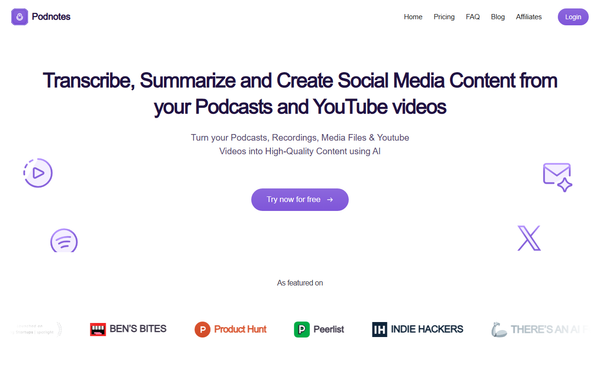
Podnotes is an AI-powered platform that transforms podcasts, audio recordings, video files, and YouTube content into high-quality, ready-to-use assets. It automatically generates transcripts (with speaker separation), summaries, show notes, chapters, timestamps, and repurposed content such as social media posts, threads, LinkedIn updates, newsletters, SEO-optimized blogs, Instagram captions, and short audiogram clips for TikTok, Instagram Reels, and YouTube Shorts. The primary goal is to help creators repurpose their media efficiently to grow audiences across platforms without sounding robotic.
Key use cases include turning a single podcast episode into a full marketing suite—transcripts for reference, summaries for quick sharing, blogs for SEO traffic, and social snippets for engagement. It also supports chatting directly with the content for quick insights or referencing specific moments.
The target audience includes podcasters and YouTubers focused on audience growth, content marketers and creators who repurpose media for multiple channels, ghostwriters, and agencies that produce client content in custom voices and styles. It appeals especially to those who want to scale distribution without hiring extra help for post-production.
Key Features & Capabilities
Core functionality revolves around seamless input options—uploading files, pasting YouTube URLs, or connecting RSS feeds to pull episodes automatically—followed by instant transcription and multi-format output generation. Users can organize episodes with folders and smart tags, create shareable podcast pages with embedded transcripts and summaries, and integrate with tools like Notion and webhooks.
Standout features that set Podnotes apart include the Magic Chat interface for querying any podcast or episode (e.g., “What were the key takeaways on AI ethics?”), a library of over 100 customizable style prompts that let users match their exact voice and tone to avoid generic AI output, and support for 19+ languages on both input and output. Audiogram generation turns key moments into shareable video clips, while custom prompts enable tailored assets like Substack newsletters or Medium blogs. RSS feed support and speaker-distinguished transcripts with precise timestamps add professional polish.
Compared to pure transcription tools like Otter.ai or editing suites like Descript, Podnotes differentiates with its end-to-end repurposing pipeline focused on marketing-ready content rather than just editing raw audio.
Limitations include quotas on transcription minutes (billed per plan), file upload caps around 50 MB, unspecified but existing audio length restrictions, and the absence of built-in audio/video editing capabilities. It excels at post-production repurposing but is not a full podcast studio replacement.
User Experience
Podnotes offers a low learning curve with a clean, intuitive dashboard that makes adding media effortless via drag-and-drop uploads, URL pasting, or RSS selection. The interface is thoughtfully designed for speed—most users can generate full outputs in minutes without tutorials.
Navigation feels modern and minimal, with clear sections for transcripts, summaries, content libraries, and the Magic Chat window. Organization tools like folders and tags keep growing libraries manageable.
Documentation consists of a comprehensive FAQ covering common questions, plus a blog with podcasting tips (though not tool-specific walkthroughs). Support is available via contact form; users note responsiveness can vary but is generally helpful. Overall, the experience is accessible for beginners yet powerful for pros, with no steep onboarding required.
Performance & Reliability
Processing is fast and efficient, with transcripts, summaries, and content assets typically ready within minutes even for longer episodes. Accuracy for speaker diarization and language support is strong, and outputs feel natural when using custom styles.
No widespread outages or major reliability problems were reported in 2026 reviews. Occasional minor bugs (e.g., temporary upload glitches) have been noted in user feedback but appear fixed quickly via updates. Common complaints are limited to support wait times in rare cases and the need to stay within transcription minute limits for heavy users. Overall, the tool performs reliably for its intended repurposing workflow.
Pricing & Value
Podnotes offers a generous free trial with 50 minutes of transcription (plus unlimited summaries and content generation during trial). There is no permanent free tier.
The three paid plans are:
- Starter ($49/month) – suitable for light users with moderate transcription minutes.
- Pro ($99/month) – expands minutes and features for regular creators.
- Agency ($199/month) – includes 3,200+ transcription minutes, unlimited summaries/content/audiograms, and full team-friendly tools.
Annual billing provides a 20% discount across plans. Higher tiers unlock more transcription time while keeping content generation unlimited, plus extras like advanced integrations.
Value is strong for creators who produce regular episodes and want to repurpose into multiple formats without juggling tools. Compared to alternatives (Descript’s higher editing-focused pricing or Otter’s transcription-only focus), Podnotes delivers broader marketing output at competitive cost—especially for agencies or ghostwriters. The custom style library and Magic Chat provide unique ROI by saving hours on manual writing and research.
Practical Tutorial
No extensive official video tutorial exists, but the site’s free tools page and FAQ provide quick-start guidance. Here is a complete step-by-step walkthrough for the common task of turning a YouTube podcast episode into a full content suite (tested conceptually from site descriptions and user examples).
- Sign up at https://www.podnotes.app/ for the free trial (50 minutes included). Verify your email and land on the clean dashboard.
- Click “Add Podcast” or the equivalent upload button. Choose your input: paste a YouTube URL (example: a popular episode like “Joe Rogan Experience #2000”), select an episode from an RSS feed, or upload an MP3/MP4 file (under 50 MB).
- Podnotes processes the file automatically. Within minutes, review the speaker-separated transcript with timestamps and chapters, plus auto-generated summary and show notes.
- Go to the “Generate Content” section. Open the Style Library (100+ prompts) or create a custom one matching your brand voice. Select outputs: e.g., “Twitter Thread,” “LinkedIn Carousel Post,” “SEO Blog for Medium,” or “Substack Newsletter.” Apply a custom prompt like “Write an engaging Instagram caption series highlighting the top 3 insights on productivity, in a conversational tone.”
- Generate audiograms for key moments by highlighting timestamps and clicking the audiogram tool—ideal for short social clips.
- Use Magic Chat: type questions like “Extract quotes about remote work challenges” to pull references instantly. Organize the episode into a folder, tag it, and share the public podcast page link.
- Export everything (transcripts, posts, blog drafts) or push to Notion via integration. For the example, a 60-minute Joe Rogan episode yields a ready Twitter thread, full blog draft, and 3 audiograms in under 10 minutes of active time.
For practice, try the free tools at https://www.podnotes.app/free-tools (e.g., Free YouTube Video To Content Generator) before upgrading.
Final Verdict
Podnotes earns a solid 4.5 out of 5. It shines as a time-saving powerhouse for anyone serious about turning spoken content into multi-channel assets quickly and in their own voice.
Podcasters, YouTubers, content marketers, and agencies should use this tool because it delivers end-to-end repurposing—transcripts through social-ready posts and blogs—with custom styles and Magic Chat that competitors rarely match in one place.
Avoid it if you primarily need advanced audio/video editing (use Descript instead), require unlimited free transcription for very high volume, or prefer mobile-first apps, as the web-only experience and minute quotas may frustrate those users.
Podnotes is an indispensable repurposing engine that turns one podcast into an entire content marketing machine—highly recommended for growth-focused creators.