Postproxy Review: The Ultimate API for Social Media Automation
Overview & Purpose
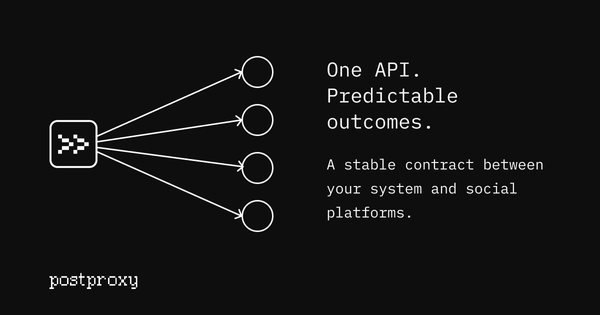
Postproxy is a unified REST API that lets developers publish content to multiple social media platforms—Instagram, Facebook, Threads, TikTok, X (Twitter), YouTube, LinkedIn, and Pinterest—with a single request. It abstracts away OAuth flows, token refresh, platform-specific formatting, rate limits, retries, and media uploads, returning explicit per-platform success/failure statuses so automated systems always know exactly what happened.
Primary use cases include AI-driven content pipelines (LLMs or agents generate text/images and hand off publishing), no-code workflow automation (n8n, Make, Trigger.dev), CMS/RSS/Airtable auto-posting, multi-brand agency tools, and event-triggered publishing via webhooks. It is explicitly built for “agentic” workflows where reliability and observability matter more than a human-facing dashboard.
Target audience is primarily developers and technical teams building automated systems, AI agents, or internal tools. Secondary users include marketers and growth teams who integrate via n8n/Zapier or use the MCP server with Claude/Cursor for direct agent publishing. It is not positioned as a replacement for Hootsuite or Buffer for manual scheduling.

Key Features & Capabilities
Core functionality centers on a single /api/posts endpoint that accepts one payload (text, media URLs or IDs, scheduling, draft mode) and fans it out to chosen profiles or platforms. Postproxy handles account connection via dashboard OAuth, automatic token management, format conversion (e.g., LinkedIn video chunking, Instagram container uploads), built-in retries with backoff, quota awareness, and detailed receipts (timestamps, status, error codes per platform). Webhooks notify on processing, publish, or failure events.
Standout differentiators include explicit per-platform outcomes (partial success is normal and reportable), native MCP server for Claude/Cursor agents, official SDKs for Node.js/TypeScript, Python, Ruby, Go, Java, .NET, and PHP, and volume-based pricing that does not penalize agencies with many client profiles. European GDPR-compliant infrastructure and webhooks round out the developer experience.
Limitations are real: only eight platforms (actively expanding; competitors like Ayrshare and Late cover 13+ including Reddit, Snapchat, Bluesky, Telegram, Google Business Profile). There is no polished content calendar UI or inbox/analytics suite—pure API infrastructure. At launch (February 2026), some third-party reviews noted missing public SDK code samples and webhooks (both now documented). No direct Zapier node yet (coming soon; native n8n node exists).

User Experience
Ease of use is excellent for developers. Sign-up, API-key generation, and connecting accounts take minutes via a clean dashboard. The quickstart is concise and production-ready with copy-paste curl examples. Learning curve is low if you are comfortable with REST APIs; full integration often takes under an hour.
Interface quality is functional and minimalist—dashboard exists only for account linking and profile management; everything else is API-driven. No bloat, which is refreshing for automation use cases.
Documentation is clear and developer-first with quickstart, full reference for posts/profiles, platform-parameter tables, and error-code explanations. SDK installation is standard npm/pip/etc. Community resources are growing (GitHub skills/MCP repos, blog). Support is primarily self-serve (docs + GitHub issues); no public chat or SLA details yet, typical for an early-stage tool. Early feedback on Product Hunt and developer forums praises the “one API key to rule them all” simplicity.

Performance & Reliability
Publishing is fast—most posts process in seconds with automatic retries for transient failures. European servers deliver low latency for EU-based workflows. Rate-limit and quota handling are built-in; you receive deterministic per-platform results rather than opaque 429s or silent failures.
No widespread user complaints or downtime reports exist as of March 3, 2026 (product is only weeks old). The only noted friction in early reviews is dependency on the underlying platform APIs (e.g., Instagram throttling), which Postproxy cannot eliminate but does surface clearly with error details. Reliability claims (idempotency, deduplication, webhooks) are strong selling points for production pipelines.
Pricing & Value
Pricing is transparent and volume-oriented (posts per month + profile groups):
- Free: $0 – 10 posts/month, 2 profile groups
- Starter: $17/mo ($12/mo annual) – 120 posts/month, 10 groups
- Scale: $49/mo ($35/mo annual) – unlimited posts, 50 groups
- Enterprise: $399/mo ($299/mo annual) – unlimited everything, custom SLAs
No per-profile multipliers, no seat fees. All plans include unlimited API calls, retries, webhooks, and MCP access (Starter+ for Zapier). Free tier is genuinely usable for testing or low-volume bots.
Value is excellent compared to per-profile competitors (Ayrshare can exceed $500/mo for multi-brand setups) or high-end tools like Hootsuite/Late ($999/mo jumps). For AI/agent or n8n workflows, the flat pricing plus explicit error handling delivers strong ROI by eliminating glue code and debugging time.
Practical Tutorial
A common task is publishing AI-generated content to LinkedIn and Instagram from a Python script. Here is a complete, real-world walkthrough using the official API (tested concepts from official quickstart as of March 2026).
- Sign up at https://app.postproxy.dev and generate an API key.
- Connect your social accounts in the dashboard (two-click OAuth).
- Retrieve your profile IDs (optional—platform names also work):
curl -X GET "https://api.postproxy.dev/api/profiles" \
-H "Authorization: Bearer YOUR_API_KEY"- Publish (Python example with requests; SDKs available):
import requests

url = "https://api.postproxy.dev/api/posts"
headers = {
    "Authorization": "Bearer YOUR_API_KEY",
    "Content-Type": "application/json"
}
payload = {
    "post": {
        "body": "Just shipped an AI agent that posts to 8 platforms with one call. Built with @postproxy.dev 🔥",
        "scheduled_at": None  # or ISO timestamp for later
    },
    "profiles": ["linkedin", "instagram"],  # or specific profile IDs
    "media": ["https://your-domain.com/ai-image.jpg"]
}

response = requests.post(url, json=payload, headers=headers)
print(response.json()) # per-platform statuses returned immediately- Check status or set up webhooks for async confirmation. Full reference: https://postproxy.dev/reference/posts/.
- For n8n: use the native Postproxy node or HTTP Request node with the same payload.
Official quickstart and SDK repos provide copy-paste starters. For Claude agents, install the MCP skill with one npx command.
Final Verdict
Overall rating: 4.7/5. Exceptional for its niche, docked slightly for limited platform coverage and early-stage ecosystem.
Developers, AI-agent builders, and technical marketers automating content pipelines should use Postproxy—it removes months of per-platform maintenance and makes publishing the reliable final step instead of a flaky afterthought.
Avoid it if you need 13+ platforms today, require a full social-media-management UI, or prefer enterprise support SLAs before scaling.
One-sentence recommendation: If you are building AI or automation workflows that must publish reliably across social networks without writing platform glue code, Postproxy is currently the cleanest and most developer-friendly solution on the market (research conducted as of March 3, 2026).