Qodex AI Review: Automate API Testing and Security with Ease

Overview & Purpose
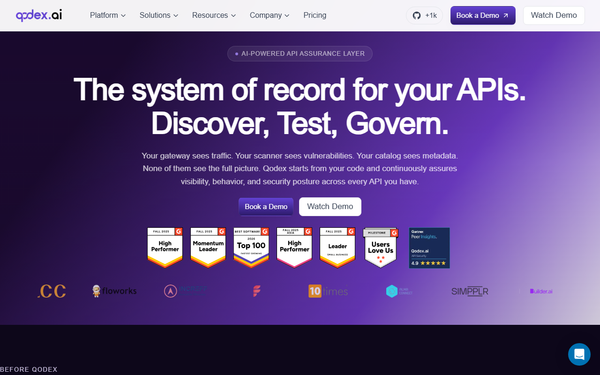
Qodex.ai is an AI-powered API testing and security platform that serves as a "System of Record for Your APIs," focusing on discovery, testing, and governance directly from code or API specifications. It automates the full testing lifecycle by generating functional, regression, and security tests from plain English prompts, Postman collections, or Jira stories; auto-detecting schema/behavior drift; and committing tests as version-controlled code to Git for seamless CI/CD execution. Primary use cases include achieving 100% API coverage without manual scripting, catching bugs and vulnerabilities pre-production, reducing deployment cycles (e.g., from 5 days to 2), and providing real-time Slack alerts for failures or performance drops. It validates over a billion API calls monthly for engineering teams.
Target audience is primarily developers, QA engineers, security teams, and engineering leaders at startups to enterprises building API-driven applications (REST, GraphQL, etc.). It appeals to teams tired of outdated Postman collections or fragile manual tests, especially those integrating security (OWASP Top 10) into every build. It is not a general-purpose UI/web/mobile testing tool—its strength is API assurance from code-first discovery (including shadow endpoints).
Key Features & Capabilities
Core functionality revolves around an AI Agent that turns natural-language descriptions into executable test code (YAML + JavaScript), auto-generates request data/payloads, and applies assertions. Standout differentiators include:
- 100% code-based API discovery (no agents needed; scans repos in <5 minutes, capturing unowned/shadow routes competitors miss).
- Auto-healing: detects drift on releases and suggests one-click fixes.
- Tests committed to Git for version control, local CLI runs, and pre-commit hooks.
- Built-in OWASP-aligned security testing (penetration, injection, rate limits, headers) in every CI build.
- Database validation via read-only SQL queries and support for tokens/cookies/OTPs.
- Real-time monitoring, Slack/email alerts, and interactive documentation.
These features set it apart from traditional tools like Postman or Swagger by eliminating maintenance and turning tests into living, Git-native artifacts. Integrations cover GitHub/GitLab/Bitbucket, major CI/CD (GitHub Actions, Jenkins, etc.), Jira (Premium+), Slack, and Postman imports.
Limitations include restriction to API testing only (no UI/browser automation), consumption of AI tokens for generation/updates (executions are unlimited), and reliance on repository access or spec files for full discovery. No offline mode or extensive custom scripting beyond JavaScript extensions. Advanced runtime threat protection is Enterprise-only.
User Experience
Onboarding is exceptionally smooth with a low learning curve—most users are productive in under 10 minutes via a clean, chat-based AI Agent interface in the web app. Navigation is intuitive: dropdowns for collections, chat for prompts, visual build reports, and one-click Git sync. The platform feels modern and developer-friendly, with plain-English rule writing and "Fix Me" AI debugging.
Documentation exists (detailed guides on docs.qodex.ai) but receives mixed feedback—some users call it "poor" or incomplete for edge cases. Support is community-driven on the free tier and expert 24/7 on paid plans. Overall, the interface quality earns high praise for simplicity and speed of test creation.
Performance & Reliability
Test generation and execution are fast: API inventory in minutes, full suites runnable in one click, and CI/CD integration keeps pipelines lightweight. Auto-healing and drift detection reliably catch changes, with real-world examples showing deployment acceleration and 100% coverage gains. The platform handles high volumes (millions of tests monthly) without downtime.
Common user complaints center on occasional slow loading of detailed reports and build histories, which can frustrate large suites. No widespread reliability issues or outages reported; testimonials highlight consistent Slack alerts and pre-production bug catching. Reliability is strong for API-focused workloads, though report performance could improve.
Pricing & Value
Qodex.ai offers transparent tiered plans (usage-based on AI tokens for generation/updates; unlimited test executions):
- Basic (Free): Up to 100 endpoints/month, 12,500 tests/month, alerting/reporting, 24/7 community support. Ideal for evaluation.
- Premium (Recommended): Up to 500 endpoints/month, 200,000 tests/month, Jira + full CI/CD integrations, expert support.
- Enterprise: Unlimited everything + advanced security (runtime protection, data redaction, mTLS, webhooks). Custom pricing.
No public per-month USD pricing is listed—Premium/Enterprise require demo/contact; trial accounts start with 500,000 tokens. Value is excellent compared to manual QA or competitors: teams report 200% faster shipping at ~20% of traditional QA budgets, with zero-code automation and Git-native tests delivering immediate ROI for API-heavy teams. Free tier lowers barriers, though scaling quickly hits limits.
Practical Tutorial
A common task—importing a Postman collection and generating/running end-to-end tests—takes ~10 minutes. Official walkthrough available at https://docs.qodex.ai/getting-started. Here is a real step-by-step example:
- Sign up at app.qodex.ai and land in the AI Agent chat.
- Click “Add Collection” (top-left dropdown) and upload your Postman .json file (or Swagger/OpenAPI). The collection auto-selects.
- In the chat, type a plain-English prompt, e.g., “Write end-to-end user onboarding tests including signup with missing email error and token expiration on protected routes.” AI proposes scenarios—review and click Save.
- On the scenario page, click “Create Request Data”; AI auto-fills payloads/headers. Edit manually if needed and select your .env.staging environment for tokens.
- Scroll to Test Rules—accept AI suggestions or add custom ones like “Response time should be < 1000ms” or “Status 401 if token invalid.”
- Click Run (select environment), view instant results in the Build panel. Failed tests show ❌; click “Fix Me” for AI suggestions.
- (Optional but recommended) Go to Test Scenarios tab → Sync to GitHub to commit tests as code.
- Add scenarios to a Test Suite/Plan, schedule daily runs, and enable Slack alerts.
Tests now run in CI/CD automatically. For database checks or security, extend rules accordingly. Full CLI and auto-healing details are in the docs.
Final Verdict
Qodex.ai earns a strong 4.6/5 rating (based on G2’s 4.9/5 across 60+ reviews and limited Gartner data as of March 2026). It excels for engineering teams that want AI-driven, zero-maintenance API testing integrated into Git and CI/CD.
Who should use this tool: API-centric development/QA/security teams at any scale seeking to eliminate manual scripting, achieve full coverage, and bake security into every release—especially those already using Postman, Git, or Jira.
Who should avoid this tool: Teams focused primarily on UI/browser/e2e testing (not API-only), organizations needing fully transparent public pricing or exhaustive documentation, or very small teams unlikely to exceed free-tier limits quickly.
One-sentence recommendation: If your team ships APIs and wants to replace manual QA with intelligent, Git-native automation, Qodex.ai is one of the smartest investments you can make today.