Master AI Detection with Real Or Fake Text: A Full Review
Overview & Purpose
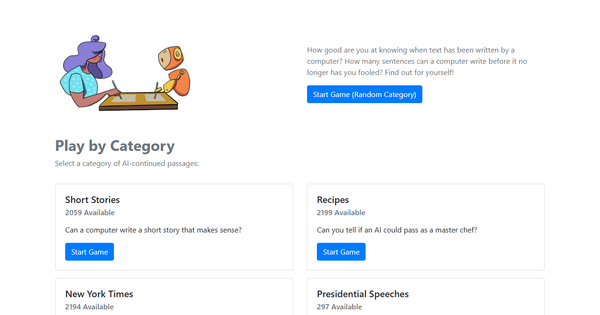
Real or Fake Text (RoFT) at https://roft.io/ is a free, web-based interactive game and research platform that tests and trains users' ability to distinguish between human-written text and AI-generated text. Players engage in "boundary detection" challenges where passages begin with guaranteed human-written prompts and may switch to computer-generated continuations at some point. The primary use cases include personal skill-building in AI literacy, classroom activities for teaching critical thinking about generative AI, and contributing to academic research on human detection capabilities.
The tool targets educators, students, writers, content creators, and anyone curious about AI's capabilities and limitations. It is particularly valuable for AI literacy programs, as it gamifies the process of spotting machine errors in realistic scenarios like continuing a story or article.
Research for this review was conducted on April 11, 2026, drawing from the official website, associated academic papers, UPenn resources, and GitHub documentation.

Key Features & Capabilities
Core functionality revolves around sentence-by-sentence gameplay: the first sentence is always human-written, and players progressively reveal subsequent sentences while deciding whether each remains human-authored or marks the AI switch point. Upon guessing the transition, users can optionally explain their reasoning (e.g., identifying common-sense, logical, or relevance errors typical of AI). Immediate feedback reveals the true boundary, awards points based on precision (higher for exact matches, decreasing for nearby guesses), and allows replaying passages.
Standout features include:
- Four specialized categories with thousands of passages: Short Stories (approximately 2,059 available), New York Times-style news articles (approximately 2,194), Recipes (approximately 2,199), and Presidential Speeches (approximately 297).
- Random category mode for variety.
- Free user accounts for saving progress, avoiding repeat passages, viewing personal stats, and competing on a global leaderboard.
- Research-backed design originating from University of Pennsylvania studies, using datasets from sources like the New York Times Annotated Corpus, Reddit Writing Prompts, Recipe1M+, and presidential speeches, originally generated with models such as GPT-2, GPT-2-XL, and CTRL (with some later GPT-3 updates).
Differentiators from competitors (such as binary AI text detectors like GPTZero or Originality.ai) include its focus on interactive boundary detection rather than yes/no classification, gamification with scoring and explanations, and dual role as both entertainment and data-collection tool for advancing human-AI detection research.
Limitations include reliance on a fixed dataset from older language models (potentially less representative of 2026-era AI like GPT-4o or Claude), a relatively small number of passages in the Presidential Speeches category, and no support for custom text uploads or modern model testing. There are no advanced analytics, mobile-optimized features, or integration with other tools.
User Experience
The interface is clean, minimal, and web-based with straightforward navigation (Play, Help, About, Leaderboard, Log In, Save Progress). Getting started requires no account—users can jump straight into a random or category-specific game via prominent "Start Game" buttons. The learning curve is low for basic play but may take a round or two to master the boundary-detection mechanic and error-explanation step.
Interface quality is functional rather than polished: text displays clearly sentence-by-sentence with simple click-to-continue or label buttons. No heavy graphics or distractions, making it accessible across devices, though it remains desktop-primary. Help and About sections (accessible via top navigation) provide rules and background, though some users note the initial mechanics feel slightly unintuitive without reading them first.
Documentation is concise and embedded in the site, supplemented by academic papers and UPenn articles for deeper context. No formal support ticketing exists, but the academic origins mean community discussion often occurs in education forums or via the original researchers' publications. Overall, the experience feels engaging and educational rather than commercial.
Performance & Reliability
The game loads and responds instantly as a lightweight web application, with no reported speed issues even during extended play sessions. Passages generate reliably from the pre-existing dataset, and scoring feedback is immediate.
Known issues are minimal and mostly tied to the academic nature of the project: occasional repetition of passages for non-logged-in users, and the dataset's age means modern AI might produce subtler errors not fully represented. Public user complaints are sparse due to the niche audience; one aggregator site reported an average of 2.75/5 from a small sample of 8 reviews, citing repetitiveness, but broader feedback from educators highlights its reliability for classroom use. No major outages or bugs were noted in recent references as of 2026.
Pricing & Value
Real or Fake Text is completely free with no tiers, ads, or paid upgrades. Login is optional and cost-free, providing full access to progress saving, leaderboards, and all categories. There are no enterprise options or premium content.
The value proposition is excellent for its niche: it delivers research-grade training in AI detection without cost, outperforming many paid detectors by focusing on skill development rather than automated labeling. Compared to alternatives (free binary detectors or paid enterprise tools), RoFT stands out for engagement and educational depth, though it is not positioned as a professional verification service.
Practical Tutorial
A common task is completing a full round in a chosen category to improve detection skills and contribute to the leaderboard. Here is a step-by-step walkthrough (based on the live site mechanics as of April 2026):
-
Visit https://roft.io/ and click "Start Game (Random Category)" or select a specific category under "Play by Category" (e.g., Short Stories for creative writing practice).
-
Optionally click "Log In" (or sign up with email/Google) to save progress and track stats across sessions.
-
The game begins with the first sentence displayed and labeled as human-written. Read it carefully.
-
Click to reveal the next sentence. Decide if it continues in the human author's style or marks the AI switch. Click the appropriate button ("Human" or "Computer/AI"). If choosing AI, an optional text box appears for noting error types (e.g., "logical inconsistency" or "relevance error").
-
Continue sentence by sentence (typically up to ~10 sentences total) until you guess the switch point or reach the end. The system stops you once the actual boundary is passed.
-
Receive instant scoring: maximum points (e.g., 5) for exact boundary detection, with deductions for early or late guesses. View the true switch point, AI error examples, and your explanation feedback.
-
Review your round stats, then click to start the next passage. Check the Leaderboard via the top menu to compare global high scores.
For official context, refer to the site's Help section or the 2023 AAAI paper linked from related UPenn resources. Educators can integrate this into lessons by having students play 5–10 rounds and discuss detected errors.
Final Verdict
Overall rating: 4.2/5 – a strong educational tool that excels in engagement and research value but is held back slightly by its dated dataset and basic interface.
Who should use this tool: Educators, students, writers, and AI-curious individuals seeking a fun, effective way to build practical skills in spotting AI-generated text while contributing to ongoing research.
Who should avoid this tool: Professional content verifiers needing up-to-date commercial AI detectors or users seeking advanced customization and modern model testing.
One-sentence recommendation: Real or Fake Text is a cleverly designed, free research game that turns AI detection training into an addictive and enlightening experience anyone can benefit from.