ResearchCollab AI Review: The Ultimate AI Research Operating System
Overview & Purpose

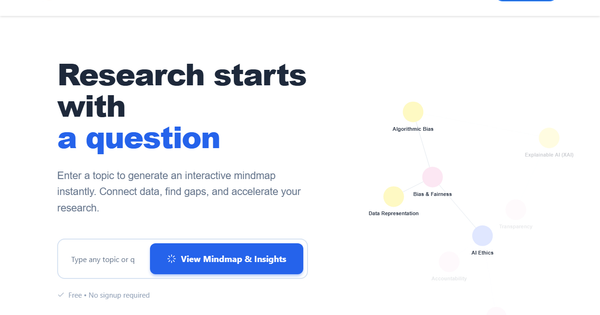
ResearchCollab.ai is an AI-powered research platform that functions as a centralized “operating system” for academic, scientific, and professional workflows. Users begin by entering any research topic or query to instantly generate interactive mind maps drawn from a database of over 250 million academic papers. The tool then helps connect data points, identify research gaps, automate literature analysis, organize materials with tags and folders, generate citations and outlines, brainstorm fresh ideas, and facilitate private team collaboration.
Primary use cases include accelerating literature reviews, drafting initial sections of papers or dissertations, overcoming creative blocks in idea generation, managing citations and references, and enabling secure team-based knowledge sharing. It targets a broad audience: undergraduate and postgraduate students, academic researchers, educators building courses, professionals conducting competitive intelligence or market research, research teams, and entire institutions seeking campus-wide licenses. Launched publicly in January 2026, the platform addresses fragmented toolchains by unifying discovery, analysis, organization, and collaboration in one privacy-focused environment.

Key Features & Capabilities
Core functionality revolves around an AI Research Assistant that performs “research on autopilot”: searching the 250-million-paper database, summarizing uploaded PDFs (machine-readable only), extracting metadata/arguments/methods, answering targeted questions via in-document chat, and suggesting related work or gaps. Additional capabilities include instant mind-map generation from any topic, customizable analysis templates, automatic citation generation (APA, MLA, Chicago, Harvard), tailored outline creation, background auto-categorization of papers, and progress tracking via visual milestones.
Standout differentiators include visual mind maps for spotting “white space” in literature, dual-model verification to reduce hallucinations, seamless Zotero and Mendeley integration, cloud-storage sync (Google Drive, Dropbox, OneDrive), and private collaboration workspaces where team members can share insights without exposing the full research base. The platform emphasizes transparency and auditability—every AI insight links back to source text—making it suitable for reproducibility-focused workflows.
Limitations and missing features: analysis is restricted to PDF files (scanned documents require external OCR); AI accuracy depends on document quality and query specificity; lower-tier plans cap exports, deep-research runs, and custom templates; no native support for non-PDF formats or bulk processing beyond drag-and-drop; and, as a relatively new tool, it lacks the extensive third-party plugin ecosystem of older reference managers. Processing times can vary with file size and server load.
User Experience
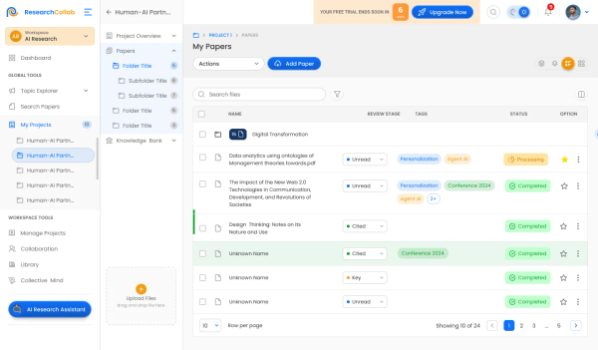
The interface is modern, clean, and highly intuitive with drag-and-drop uploads, instant topic-to-mind-map demos available without sign-up, and real-time syncing across devices. Most users report a minimal learning curve—basic exploration works immediately, while deeper features (projects, tags, collaboration) follow logical workflows guided by the built-in knowledge base.
Documentation includes a comprehensive self-service knowledge base with searchable tutorials, troubleshooting guides, a product roadmap, and a feedback/wishlist portal, plus email support answered within 24 hours. A 30-day money-back guarantee and free tier further lower barriers. No steep onboarding is required, though power users may spend time mastering custom templates and workspace permissions.
Performance & Reliability
Mind-map generation and basic searches are near-instantaneous. Paper analysis and summarization occur in the background, typically completing within seconds to minutes depending on length and complexity. The 250-million-paper index delivers credible, up-to-date results, and private workspaces maintain strict end-to-end encryption with role-based access.
As of March 2026, no widespread outages or major reliability complaints appear in public forums or review aggregators—unsurprising given the tool’s recent launch. Occasional delays with large or scanned PDFs are noted in the FAQ, and AI outputs occasionally require query refinement to avoid generic responses. Overall stability is high for an early-stage platform, with continuous updates visible via the public roadmap.
Pricing & Value
ResearchCollab.ai offers a generous free tier (200 AI credits/month, 200 MB storage, basic features) that lets users test mind maps, limited uploads, and core analysis without a credit card. Paid plans are credit-based and scale as follows (approximate structure confirmed via site):
- Starter tier (~2,000 credits/month)
- Plus tier (6,000 credits/month, labeled most popular)
- Professional tier (25,000 credits/month, ~$39.99 billed monthly or lower annually)
Higher tiers unlock unlimited search/export, unlimited notes/bookmarks, more workspaces/projects, custom templates, dedicated support, and larger storage (up to 70 GB). Enterprise and institutional site licenses are available with custom seat-based pricing, SSO, and advanced admin controls. A 30-day money-back guarantee applies, and referral programs reward users with extra credits.
Value proposition is strong for students and solo researchers who can operate comfortably on free or low-tier plans, while teams benefit from shared workspaces and integrations that reduce switching costs versus using separate tools (Elicit + Zotero + Notion). At current pricing it undercuts some all-in-one competitors for mid-volume academic use, though heavy users may need to monitor credit consumption.
Practical Tutorial
Official resources include a 1-minute YouTube overview video and the platform’s knowledge-base tutorials. Below is a complete step-by-step walkthrough for a common task—analyzing a research paper, identifying limitations, and generating a literature-review outline—tested on the public demo flow as of March 2026.
-
Visit https://researchcollab.ai/ and, without signing up, type a topic (e.g., “AI ethics in healthcare”) into the search bar to generate an interactive mind map instantly. Click nodes to explore sub-topics and gaps.
-
Click “Try for Free” or “Sign Up” (email only) to access full features. Create a new Project via the dashboard.
-
Inside the project, click “Add Paper” and drag-and-drop a PDF (or import from Zotero/Mendeley). The AI automatically extracts metadata, summarizes sections, and identifies arguments, methods, and citations in the background.
-
Open the paper card and use the AI Chat panel: type “Summarize the limitations and methodology weaknesses” or “Compare findings with the top 3 related papers.” The assistant pulls directly from the uploaded text and suggests follow-up questions.
-
Switch to the “Organize” tab: apply custom tags (e.g., “limitation-ethics”), move the paper into a folder, and add personal notes or annotations. Invite collaborators via email with view/comment/full-access permissions.
-
Click “Generate Outline” or “Create Template,” select a literature-review template, choose key papers, and let the AI produce a structured outline complete with in-text citations and bibliography (exportable in APA/MLA).
-
Export the full package (outline + summaries + mind-map screenshot) or continue brainstorming by asking the Topic Explorer for “fresh research directions to overcome these limitations.”
Total time for a single paper: under 10 minutes. For deeper guidance, refer to the official YouTube demo “Research Made Easier – Quick Look at ResearchCollab” or the in-app knowledge-base article “Uploading and Analyzing Papers.”
Final Verdict
Overall rating: 4.6/5. ResearchCollab.ai excels as a focused, privacy-first research operating system that genuinely accelerates the full workflow from discovery to drafting while keeping users in control.
Students, early-career researchers, educators, and small teams should use it because the free tier plus intuitive mind maps and seamless integrations deliver immediate productivity gains without the fragmentation of competing stacks. Large institutions will appreciate the enterprise controls and auditability features.
Avoid it if you require heavy non-PDF support, unlimited high-volume processing on a zero-budget, or advanced collaborative writing/editing beyond annotation—traditional tools like Zotero + Overleaf may still suit those niches better.
One-sentence recommendation: If you want an all-in-one AI research platform that turns chaotic literature piles into structured, citable insights with almost zero setup, start with ResearchCollab.ai today—research conducted March 2026.