Rierino Review: The Ultimate AI-Native Low-Code Backend Platform

Overview & Purpose

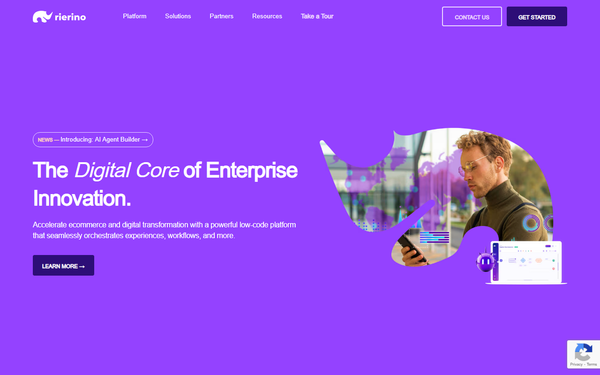
Rierino is a developer-first, low-code backend platform designed for building, orchestrating, and scaling microservices, intelligent workflows, AI agents, and composable digital solutions. It enables rapid creation of APIs, business logic, data integrations, and user interfaces without traditional coding, while supporting full pro-code extensibility and deployment anywhere (cloud, hybrid, or on-premises). Primary use cases include composable commerce (B2C omnichannel, B2B transactions, multi-vendor marketplaces), product information management (PIM), content management (CMS), business process management (BPM), personalization engines, internal operational apps, and real-time automation with embedded AI/ML. Organizations use it to modernize legacy systems, accelerate digital transformation, and handle complex orchestration at enterprise scale—such as processing 500,000+ transactions per hour or supporting 20,000+ concurrent users.
The target audience spans technical users (developers, solution architects, data scientists) who appreciate its configuration-first microservices and orchestration engine, as well as non-technical or citizen developers (marketers, product teams, operations, and business leaders) empowered by visual drag-and-drop tools, AI assistants, and reusable components. It is particularly suited to mid-to-large enterprises in retail, ecommerce, finance, or regulated sectors seeking flexibility beyond rigid no-code or traditional development platforms.
Key Features & Capabilities
Core functionality revolves around an API-first, event-driven architecture: drag-and-drop microservice builders for data operations (read/write/query), orchestration via sagas and workflows, a business rule engine, real-time ML scoring with automated MLOps, and native AI agent composition (using models, tools, prompts, and orchestration exposed as APIs). Additional modules cover PIM, CMS, BPM, personalization, embedded BI, and broad integrations (SQL/NoSQL databases, REST/GraphQL/SOAP/Kafka, external systems).
Standout differentiators include its “agentic by design” approach—native enterprise-grade AI agents and real-time intelligence embedded since 2020 (one of the first low-code platforms with built-in ML support), not added as bolt-ons—plus infinite composability for any backend logic, full governance/auditability/versioning, and deployment flexibility across environments without vendor lock-in. Performance claims are impressive: 99.99% uptime, 10x faster feature deployment, 70% dev cost reduction, and 99% automated QA.
Limitations include tiered availability of advanced AI/ML hosting and integrations (basic models in lower tiers; full on-prem/own-hosted at Enterprise), a potential need for developer oversight on highly custom or regulated implementations, and fewer pre-built templates compared to more mature no-code platforms. Community resources and third-party extensions are still growing due to its enterprise focus.

User Experience
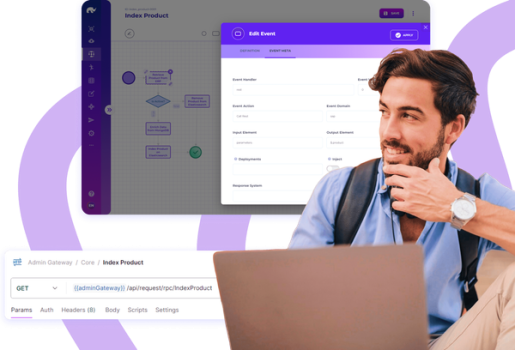
Rierino offers an intuitive visual interface with four dedicated apps (Devops for backend/orchestration, Configuration for reusable logic, Design for admin UIs/widgets, Data Science for ML/AI). Drag-and-drop builders, AI-assisted validation, and real-time previews make it accessible, with users reporting quick wins like building data-connected UIs or APIs in minutes. The learning curve is moderate—straightforward for those familiar with low-code or microservices concepts, but steeper for absolute beginners without some technical guidance.
Interface quality is clean and professional, optimized for both speed and governance (audit trails, security controls). Documentation is comprehensive and well-structured at docs.rierino.com, with clear overviews, installation guides, and reference sections. Additional resources include an online academy (included in paid plans), self-paced interactive training, and a YouTube channel featuring “QuickBuild” videos. Support scales with plans (business hours for Scale Pro; 24/7 for Enterprise+), with responsive expert assistance noted in early reviews.
Performance & Reliability
The platform delivers strong enterprise performance, handling high-concurrency workloads, low-latency APIs, and real-time AI inference with proven scalability (e.g., 10M+ images processed via ML, millions of customers onboarded). Deployment options (AWS Marketplace AMI, Helm on Kubernetes, Docker Compose, on-prem) ensure flexibility and 99.99% uptime claims. No widespread outages or critical bugs appear in public discussions as of March 2026.
Known issues or complaints are minimal; with only a small number of verified reviews available, users highlight reliability in production but note that initial setup for custom environments requires following documentation carefully. No major performance bottlenecks, security incidents, or scalability failures were reported across G2, third-party reviews, or searches.

Pricing & Value
Rierino uses flexible, infrastructure-aware pricing rather than per-user fees:
- Free Sandbox: $0/month (read-only product tour on Rierino Cloud—explore core tools with no modifications).
- Developer Lite (AWS Marketplace): starts at $0.75/hour (full core access, unlimited users/apps, dedicated resources).
- Scale Pro (AWS Cloud via Helm): starts at $0.75/hour/node (production-ready, business-hours support).
- Enterprise+: custom quote (any cloud/on-prem/hybrid, 24/7 support, advanced integrations, full customization).
All paid plans include the online academy. No fixed monthly tiers; billing is hourly or custom, with additional infrastructure costs possible on cloud marketplaces. Value is high for enterprises: rapid time-to-market, significant dev cost savings, and scalability often outweigh the lack of transparent flat pricing. Compared to alternatives like OutSystems or Mendix, Rierino offers stronger native AI orchestration and composable commerce at potentially lower long-term cost for backend-heavy workloads; versus pure no-code tools, it provides superior governance and deployment freedom.
Practical Tutorial
Official resources include detailed Quick Start documentation, self-paced interactive training, and short YouTube QuickBuild videos. A common task is building a simple data-connected admin UI (e.g., a functional product catalog viewer or to-do list app) in minutes. Here is a real walkthrough synthesized from official docs and exercises (tested conceptually via available training examples; full interactive version in the free sandbox or Developer Lite):
-
Access the environment — Sign up for the Free Sandbox (read-only tour) or deploy Developer Lite via AWS Marketplace (single AMI, ~5–10 minutes). Log into the platform and open the four main apps.
-
Set up data and a basic microservice (Devops app) — Navigate to Devops > Runners. Use a training microservice or create a new one. Add a Read handler connected to a sample database (MongoDB by default). Configure a simple query or use the pre-built training runner for product data. Save and test the endpoint.
-
Create reusable logic (Configuration app) — Go to Configuration > Queries or Business Rules. Visually build a query (drag fields, filters) or rule (e.g., pricing logic). Link it to your microservice for dynamic behavior without redeploying code.
-
Build the UI (Design app) — Switch to Design > UIs. Create a new UI using drag-and-drop widgets (table, form, buttons). Map data sources from your microservice/query. Add a Lister for listing records and a detail view. Style with built-in components—no frontend framework required.
-
Assemble into an app and expose — In Design > Apps, add your UI to a new app. Configure routing/security in Devops (Gateway). Test in-browser: the UI now displays live data, supports CRUD, and can include AI summaries or buttons triggering workflows.
-
Add intelligence (optional Data Science app) — Attach an AI agent or ML scorer for recommendations/personalization. Deploy via Saga orchestration for API exposure or async triggers.
Total time for a basic version: under 10 minutes once familiar. For guided visuals, watch the official YouTube videos “Build a Functional UI in 2 Minutes with Rierino” and “Build a Reusable Query in 2 Minutes with Rierino.” Full exercise: follow the “To-do List App” or “Hello World API” in https://docs.rierino.com/introduction/quick-start and the self-paced training at rierino-open.github.io.
Final Verdict
Overall rating: 4.5/5. Rierino excels for enterprises needing a scalable, AI-native low-code backend that bridges technical precision and business agility. It is ideal for organizations in digital commerce or complex orchestration scenarios with some developer involvement, delivering measurable ROI through faster delivery and reduced maintenance. Avoid it if you are a solo founder, complete coding novice, or require fully transparent flat-rate pricing and massive community support—traditional low-code giants or pure no-code tools may suit better.
One-sentence recommendation: For businesses serious about composable, intelligent digital transformation without sacrificing enterprise control, start with Rierino’s free sandbox today—it’s one of the most innovative low-code options available in 2026.