SciFocus AI Review: The Ultimate All-in-One Academic Toolkit
Overview & Purpose
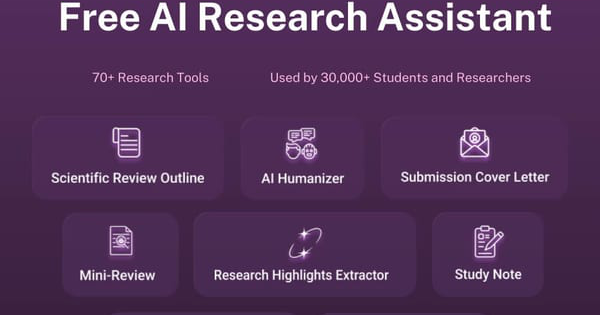
SciFocus.ai is an AI-powered research assistant that streamlines the entire academic workflow—from literature discovery and note-taking to full paper drafting, summarization, citation formatting, and revision. It combines over 70 specialized tools in its Daily Academic Toolkit with a more advanced Research Assistant Pro module to generate outlines, extract highlights, fuse content, humanize text, and support submission processes. Primary use cases include creating literature reviews, writing essays or scientific papers from bullet points or keywords, organizing notes and concept maps, responding to peer reviewers, and handling daily tasks like paraphrasing, grammar checks, and citation conversion.
The target audience is primarily students, researchers, and professionals in STEM and related academic fields—ranging from undergraduates tackling essays to PhD candidates or faculty preparing manuscripts for publication. It positions itself as a time-saving companion for anyone needing domain-specific academic support rather than general-purpose writing aids.
Key Features & Capabilities
Core functionality revolves around two main products: the Daily Academic Toolkit (essay topic generators, rewriters, checkers, paraphrasers, and grammar tools) and Research Assistant Pro (literature review outlines, mini-reviews with citations, research highlights extractor, content fusion, and submission cover letters). Users can switch seamlessly between multiple LLMs (including GPT-4o, Claude 3.5, and DeepSeek) for tailored outputs grounded in scholarly training data. Standout differentiators include its STM (Science, Technology, Medicine) expertise for context-aware academic outputs, one-click end-to-end support from hypothesis to publication, and specialized modules like automated peer-review response drafting—features that go beyond generic tools such as ChatGPT or basic paraphrasers.
The platform claims significant time savings (e.g., 95% on literature reviews, 87% on article writing). Limitations include strict monthly word quotas that reset and may constrain heavy users, the need to verify AI-generated citations and facts for accuracy (a common AI risk), and no confirmed deep integrations with reference managers like Zotero or EndNote. While some third-party listings mention real-time collaboration and adaptive learning, these are not detailed or prominently featured on the official site, making it better suited for individual rather than team-based work.

User Experience
The interface is clean, intuitive, and beginner-friendly, with simple input fields (e.g., keyword boxes with character counters) and guided prompts for each tool. The learning curve is low—most users can start generating useful output within minutes without prior AI experience. Navigation is straightforward via sections for Popular Tools, Product, and Blog, and the platform works well on desktop (mobile support is noted but less emphasized).
Documentation consists of helpful blog guides, tool-specific instructions, and a YouTube channel with tutorial videos. Support is primarily email-based ([email protected]), with no live chat or extensive knowledge base mentioned. Overall, the experience feels polished and focused on academic precision rather than flashy design.
Performance & Reliability
Generation is generally fast for outlines, summaries, and short-form content, with users and testimonials highlighting quick literature overviews and structured drafts. Reliability benefits from its scholarly-trained models, producing journal-standard formatting and evidence-based insights more consistently than generic LLMs in academic contexts. However, some users have noted slower response times compared to standalone ChatGPT or Claude, and outputs still require human oversight for hallucinations or citation accuracy.
Independent user feedback is limited due to the tool’s niche focus, with no widespread reports of major outages or data issues. Privacy is strong—data is not used for model training, with encryption and user-controlled records. Common complaints are minimal, primarily around word-limit restrictions rather than core functionality.
Pricing & Value
SciFocus offers a generous free trial (no credit card required) with limited access to core tools. Paid plans (billed monthly or annually for up to 43% savings) include:
- Basic ($6.99/month annual): 10,000 words/month in the Toolkit + 5,000 in Pro, 50 history items.
- Pro ($10.99/month annual): 50,000 Toolkit words + 7,500 Pro words.
- Ultimate ($35.99/month annual): Unlimited Toolkit + 15,000 Pro words (plus bonus), unlimited history, and early access to new features.
No enterprise tier is listed. Compared to alternatives like Jenni.ai, Paperpal, or Elicit (often $10–20/month with similar or narrower scopes), SciFocus delivers strong value through its breadth of 70+ academic-specific tools and competitive entry pricing, especially for students. Heavy users may need the Ultimate plan, but the free trial and low Basic tier make it accessible.
Practical Tutorial
Generating a Scientific Literature Review Outline (Common Task)
This walkthrough is based on the official Scientific Review Outline tool and YouTube tutorials. Real example: Topic = “The Role of CRISPR in Gene Editing for Genetic Disorders.”
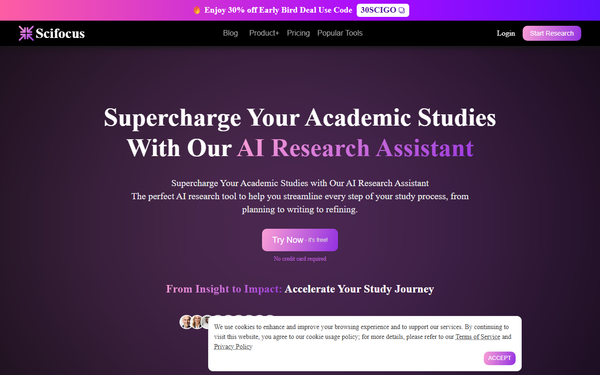
- Visit https://www.scifocus.ai/ and sign up or log in via the free “Try Now” option (no credit card needed).
- Navigate to the Scientific Review Outline tool (directly accessible at https://www.scifocus.ai/trial/scientific-review-outline or via the toolkit dashboard).
- Enter your research topic (up to 50 characters recommended) and background details in the provided fields. Example input: Topic – “The Role of CRISPR in Gene Editing for Genetic Disorders”; Background – “Focus on advances since 2020, key ethical challenges, and clinical applications.”
- Click “Generate.” The AI instantly produces a structured outline with sections such as Introduction, Key Studies, Methodologies, Major Findings, Research Gaps, Ethical Considerations, and Conclusion—complete with suggested subpoints and placeholders for citations.
- Review the output for relevance, copy it to your document, and iterate by feeding sections into other tools (e.g., Research Highlights Extractor or Paraphraser).
- For deeper dives, switch LLMs or combine with the Mini-Review generator for cited summaries.
Official video walkthrough: “How to write a review article with Scifocus?” on the ScifocusAI YouTube channel (https://www.youtube.com/@ScifocusAI). The entire process typically takes under 5 minutes and provides a solid starting framework ready for refinement.
Final Verdict
Overall rating: 4.3/5. SciFocus.ai excels for individual students and researchers who want a specialized, budget-friendly all-in-one academic AI toolkit to accelerate literature work and writing while maintaining scholarly rigor—ideal if you value domain-specific outputs and end-to-end support. Avoid it if you need unlimited free usage, robust real-time team collaboration, or deep integrations with existing reference software, as general-purpose LLMs or more established competitors may suffice at lower (or zero) cost.
SciFocus.ai is a smart, affordable investment for any academic looking to reclaim hours from routine tasks and focus on meaningful research.