Shapen Review: Turning Text and Images into 3D Models Fast
Overview & Purpose

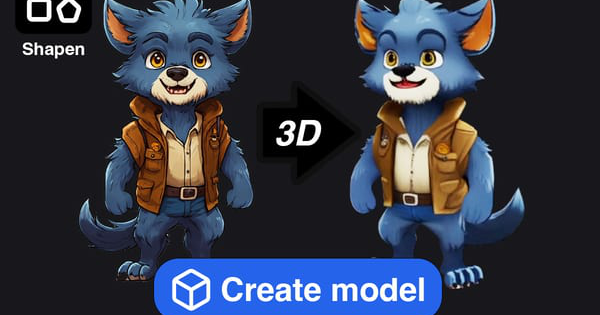
Shapen was an AI-powered web platform designed to bridge 2D concepts and 3D reality by converting text prompts into detailed images, refining those images while preserving core structure and style, and then transforming the results into high-quality 3D models. Primary use cases included rapid prototyping for animation, rendering, game development, 3D printing, and visualization of complex ideas—such as turning a text description of a “futuristic colonization spacecraft envisioned as a hybrid chicken” into a printable or animatable asset. It targeted designers, game developers, 3D artists, marketers, and hobbyists seeking an accessible entry point to professional-grade 3D workflows without traditional modeling software.
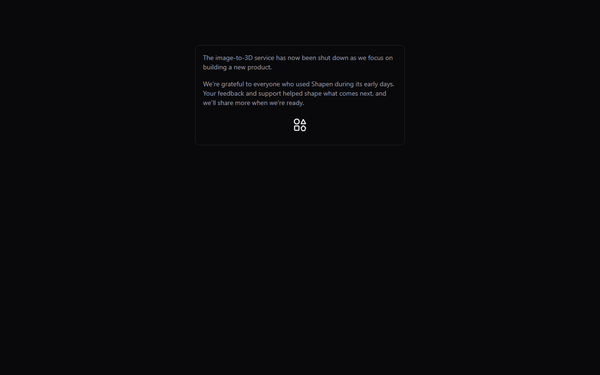
As of the research date (March 10, 2026), Shapen’s image-to-3D service has been officially shut down; the homepage now states the team is focusing on an entirely new product and thanks early users for their feedback. The review below covers the tool during its active period (approximately 2025 launch through early 2026).
Key Features & Capabilities
Core functionality revolved around a three-stage pipeline: (1) text-to-image generation with high detail, (2) image refinement and creative variation tools that maintained the original composition, and (3) single-image-to-3D conversion producing models suitable for rendering, animation, or 3D printing. It supported diverse categories including characters, animals, vehicles, architecture, electronics, and fantasy elements. Standout differentiators included seamless text-to-image-to-3D flow in one platform, emphasis on creative exploration (users could generate multiple variations while keeping structural integrity), and web-based accessibility—no downloads or complex software required.
Compared to pure image-to-3D tools like early Copilot 3D or competitors such as Meshy and Luma AI, Shapen’s integrated image-generation step gave it an edge for users starting from pure ideas rather than existing reference photos. Limitations included the now-complete shutdown of core 3D functionality, lack of advanced rigging or animation tools in the output models, and typical AI constraints such as occasional artifacts in highly complex organic shapes or inconsistent topology for production use. No native integration with Blender, Unity, or Unreal was documented at launch.
User Experience
The interface was clean, web-first, and beginner-friendly with a playground-style dashboard for quick experiments. New users could sign up and begin generating within seconds; the learning curve was minimal—most core tasks required only text prompts or single-image uploads followed by one-click refinement and conversion. Documentation consisted of training videos and online support resources, though these appear to have been removed with the shutdown. Community support was limited due to the tool’s short lifespan and modest user base (225 followers on Product Hunt at launch). Overall, the experience felt intuitive and inspiring for creative ideation, but lacked the depth or customization expected by seasoned 3D professionals.
Performance & Reliability
Generation speed was competitive for its class—text-to-image and image-to-3D steps typically completed in under a minute on standard web plans. Reliability was solid during active periods with consistent uptime reported in early user mentions, though output quality varied: textures and geometry were often “good enough” for concept work or 3D printing prototypes but required manual cleanup for production (e.g., sharper details and better coloring appeared in competing tools like Luma Labs in side-by-side tests). No widespread outages or major technical complaints surfaced in public forums, likely due to the small user base; the primary reliability issue today is the complete discontinuation of the service.
Pricing & Value
Shapen offered a free tier with limited generations and a paid plan starting at $20 per month for higher limits and priority processing. Value was strong for casual users and small teams needing fast ideation-to-3D pipelines at a lower entry price than enterprise alternatives like Meshy or Luma. The free version allowed meaningful testing, making it accessible for students and indie creators. However, with the service now shut down, long-term value has evaporated; users who invested time in workflows must migrate to active competitors. Compared to open-source options or pricier platforms, Shapen’s all-in-one approach delivered excellent convenience while it lasted.
Practical Tutorial
Official training videos and documentation were referenced on the platform but are no longer available following the shutdown. Below is a reconstructed step-by-step walkthrough for the most common task—creating a 3D model from a text prompt—based on product descriptions and early user demonstrations (e.g., the hybrid chicken spacecraft example).
- Visit shapen.com (or the archived playground at shapen.com/playground if still accessible via cache) and create a free account.
- In the dashboard, select “Text to Image” and enter a detailed prompt (e.g., “futuristic colonization spacecraft designed as a hybrid chicken with solar panel wings and landing legs, sci-fi style, highly detailed”).
- Generate the initial image; review and click “Refine” or “Variations” to iterate while preserving composition (adjust style sliders or add descriptors like “more metallic” as needed).
- Once satisfied with the 2D image, click “Convert to 3D” or upload the refined image directly into the 3D generator.
- Wait 30–60 seconds for processing; preview the 3D model in the viewer, rotate, and adjust scale or lighting if options appear.
- Download in standard formats (GLB, OBJ, or STL) for import into Blender, Unity, 3D printing software, or animation tools.
- (Optional) Return to the variations panel to generate alternative 3D versions from the same base image.
This process typically took under five minutes end-to-end and produced immediately usable assets for prototyping.
Final Verdict
Rating: 3.8/5
Shapen excelled as an accessible, creative gateway for turning ideas into 3D assets quickly and should have appealed to indie designers, game developers, and educators wanting low-friction experimentation. It is currently unsuitable for anyone due to the full shutdown of core features—avoid it unless the announced new product revives the vision. One-sentence recommendation: Shapen was a promising all-in-one text-and-image-to-3D innovator that delivered fast creative results while it lasted, but active alternatives like Meshy or Luma AI now offer more reliable long-term value.