Shiplo Review: Automate Your Browser with AI Agents Easily
Overview & Purpose
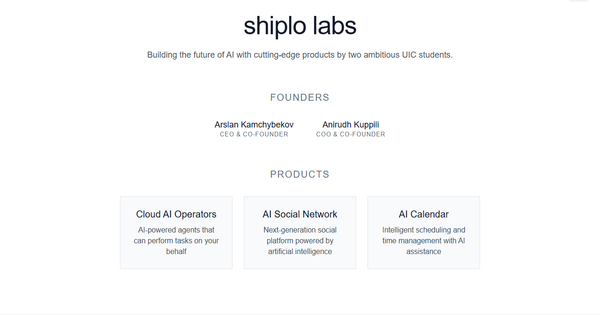
Shiplo is a digital automation platform powered by AI operators—autonomous agents that perform tasks directly in your browser, functioning like a virtual team member. Users create, schedule, and manage these operators to handle repetitive digital workflows without coding or API integrations. Primary use cases include automating job applications on platforms like LinkedIn, tracking homework or assignments, conducting web research, generating Python scripts in online editors, compiling reports, filling forms, scraping data, and organizing information. It positions itself as a “second brain,” allowing delegation of browser-based work while users retain oversight.
The target audience spans a broad range: students (homework and research), job seekers, freelancers, marketers (report generation), developers (light scripting automation), and busy professionals seeking productivity gains. It appeals especially to non-technical users who want powerful automation without technical setup, as well as teams looking to share custom operators.
Key Features & Capabilities
Core functionality revolves around natural-language operator creation: describe a task in plain English (e.g., “Apply to software engineering roles on LinkedIn using my resume”), and the AI builds and runs the agent in your browser. Operators support three control modes—manual approval (human-in-the-loop), scheduled execution (e.g., daily at 9 AM), or full autonomy. They can be chained into sequences (like microservices with shared context) and published to a global community marketplace for others to use or remix.
Standout differentiators include true browser-native execution (no Zapier-style API connectors needed), flexible autonomy levels, and the operator-sharing ecosystem—features less emphasized in competitors like Zapier, Make.com, or even newer agent platforms. It works in any language and runs in the background via web interface (mobile app in development).
Limitations include runtime caps tied to plan minutes (execution time, not calendar time), potential fragility on highly dynamic sites (common to all browser agents), no native desktop app or advanced API integrations, and privacy considerations for fully autonomous modes. Public documentation appears limited or in flux as of March 2026.
User Experience
Setup is beginner-friendly: sign up, describe your first task in natural language, and the operator is ready—no code, no API keys. The learning curve is minimal for basic use, though chaining complex sequences may require experimentation. The interface is clean and web-based, with dashboard oversight for managing operators, schedules, and community shares.
Documentation and support resources include an in-app or linked help section (tryshiplo.com/docs referenced in founder updates) plus direct founder contact. Pro and Enterprise plans add 24/7 technical support. Early beta users and directory feedback describe it as intuitive, with students and professionals noting it “feels like having a digital team working 24/7.”
Performance & Reliability
Operators run in the cloud against your browser sessions, delivering efficient automation for scheduled or on-demand tasks. Speed depends on the complexity of the site and task—simple form-filling is fast, while multi-step research or scripting can take several minutes of runtime. No widespread outages reported; recent founder updates (as of late 2025) mention bug fixes for the job-applier operator and mobile improvements.
Known issues are typical of browser automation: occasional hiccups with CAPTCHAs, site redesigns breaking flows, or login persistence. As a relatively new platform (launched ~2025 with ongoing beta refinements), independent long-term reliability data is sparse, but no major complaints surfaced on review aggregators or forums as of March 2026. Community feedback highlights steady improvements.
Pricing & Value
Shiplo uses a freemium model centered on operator runtime minutes:
- Free: $0/month – 30 minutes of runtime, unlimited operators and executions. Perfect for testing.
- Starter: $9/month – 100 minutes of runtime, community access.
- Pro: $19/month – 300 minutes of runtime, 24/7 support.
- Enterprise: Custom pricing – unlimited or scaled minutes, custom integrations, dedicated support.
Annual billing likely offers savings (not explicitly detailed). Value is strong for light-to-moderate users: the free tier lets anyone test powerful browser agents, while paid plans deliver high ROI if automation saves hours weekly. Compared to Zapier (per-task pricing) or dedicated agent tools, Shiplo’s natural-language simplicity and autonomy options provide better accessibility at a competitive cost.
Practical Tutorial
Official public tutorials are currently limited (check in-app help or https://www.tryshiplo.com/ for updates), so here is a step-by-step walkthrough for a common task—automating LinkedIn job applications—based on the platform’s documented workflow and user examples.
- Go to https://www.tryshiplo.com/ or https://agents.tryshiplo.com/ and sign up with email (free tier starts instantly).
- In the dashboard, click “Create New Operator” and enter a natural-language description: “Every weekday at 9 AM, search LinkedIn for ‘software engineer’ jobs in my city, filter by entry-level, open my resume PDF, fill the application form with my details, and submit. Skip any that require cover letters.”
- Choose control mode: select “Scheduled” (set recurrence) or start with “Manual approval” for safety.
- Upload supporting files (resume, profile data) via the operator builder.
- Review the generated steps (Shiplo shows a preview flow), then hit “Deploy.”
- Monitor in the dashboard: approve runs manually at first, view logs, or switch to full autonomy.
- (Optional) Chain with another operator: create a follow-up “Update my spreadsheet with applied jobs and send me a daily summary email.” Link them in the sequence builder.
- Share the finished operator to the community marketplace for others to adapt.
This entire process takes under 10 minutes for first-time users. For more examples (research reports, homework tracking), replicate the pattern by describing the end goal clearly and iterating on approval mode.
Final Verdict
Overall rating: 8.2/10 (strong for ease and innovation; docked slightly for early-stage documentation and browser-agent limitations).
Shiplo is ideal for students, freelancers, job seekers, and professionals who want to offload repetitive browser work without learning complex tools—especially those who value natural-language simplicity and operator sharing.
Avoid it if you need rock-solid enterprise reliability, deep API integrations, or have zero tolerance for occasional browser hiccups; established no-code platforms or custom scripts may suit better.
One-sentence recommendation: Give Shiplo a spin on the free plan—it turns your browser into a tireless virtual assistant faster than any alternative I’ve seen.