Supermemory Review: The Ultimate AI-Powered Second Brain
Overview & Purpose
Supermemory.ai is an AI-powered platform that serves as a universal memory infrastructure, functioning as both a consumer-facing digital second brain app (Supermemory Nova) for organizing and retrieving saved information and a developer-oriented Memory API for building context-aware AI applications. It enables users to save ideas, bookmarks, notes, images, videos, and data from any website, then intelligently search, connect, and interact with that knowledge through semantic tools and AI assistance. Primary use cases include personal knowledge management—such as resurfacing forgotten details from online content or chats—and providing persistent, evolving memory to AI agents for more personalized and consistent experiences across sessions.
Target audience spans students, researchers, professionals, content creators, and knowledge workers who need a reliable "second brain" to combat information overload, as well as developers, AI builders, startups (including many YC companies), and enterprises building personalized AI assistants, tutors, legal tools, or internal knowledge hubs.
Key Features & Capabilities
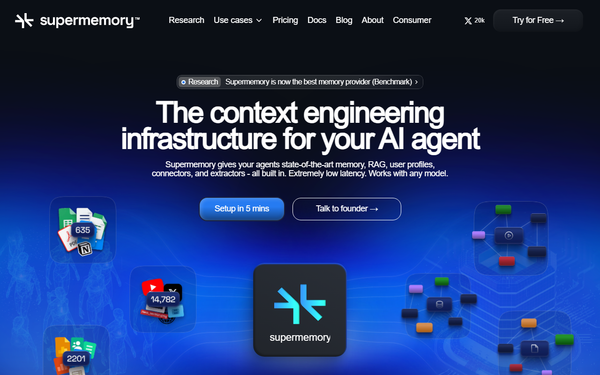
Core functionality revolves around seamless data ingestion via a Chrome extension for web content, auto-sync connectors for Google Drive, Notion, OneDrive, GitHub, and web pages, plus import tools for X/Twitter bookmarks and ChatGPT histories. Users can chat directly with their knowledge base using Nova (the built-in AI assistant), leverage a knowledge canvas for visual graph-based organization of connections, and access hybrid semantic + keyword search with automatic fact extraction, relationship mapping, and intelligent forgetting of outdated information.
Standout features that differentiate it from competitors like Mem0 or Zep include its graph-based memory engine (which evolves profiles dynamically, resolves contradictions, and updates in real time), multimodal processing for PDFs/images/videos, sub-300ms recall latency, #1 rankings across major benchmarks (LongMemEval, LoCoMo, ConvoMem), and MCP server/plugins for instant integration with tools like Claude, Cursor, VS Code, and n8n—allowing any AI assistant to "remember" you across apps. It is fully open-source (MIT license on GitHub with 16.8k stars), self-hostable (especially via plugins/MCP for consumers or enterprise options), privacy-focused with SOC 2 compliance and encryption, and supports Telegram integrations through plugins like OpenClaw.
Limitations include token-based usage caps on the free tier that may feel restrictive for heavy personal archiving, a primary cloud focus with full self-hosting geared more toward enterprise, and fewer native consumer-facing polish features compared to all-in-one tools like Notion. Missing elements for some users might include offline-first local-only mode or deeper native mobile apps beyond the web experience.

User Experience
The platform offers a low learning curve for core saving and searching tasks thanks to the intuitive Chrome extension and one-click imports, though advanced API or MCP setups involve a moderate curve for developers. The interface is modern, clean, and visually engaging, highlighted by the interactive knowledge canvas/graph view that displays auto-discovered relationships in a 2D space, responsive project organization, and seamless chat overlays.
Documentation is excellent and comprehensive at supermemory.ai/docs, featuring quickstarts, conceptual guides, API references, migration paths, and troubleshooting—supplemented by an active GitHub and Discord community. Support includes responsive email (with faster Slack channels on paid plans) and quick issue resolution noted by early users and founders who switched from competitors.

Performance & Reliability
Speed and efficiency are exceptional, with sub-300ms recall times, efficient scaling to millions of tokens per user, and consistent performance praised in benchmarks and real-world feedback (10× faster than some alternatives). It handles multimodal data, real-time syncing, and high-volume enterprise workloads (over 5 billion tokens daily globally) without noticeable lag.
Known issues are minimal and quickly addressed; early adopters reported occasional connector hiccups (e.g., indexing delays) that have been resolved, with no widespread complaints in 2026 reviews. Reliability is bolstered by SOC 2 compliance, redundant storage, and automatic memory evolution—users and switching founders highlight stability and speed improvements over rivals.
Pricing & Value
Supermemory offers a generous free tier at $0/month (1M tokens processed, 10K search queries, email support) ideal for individuals and light experimentation. Paid plans include Pro (approximately $19/month for power users), Scale (around $399/month for teams), and custom Enterprise options with unlimited usage, dedicated engineers, SLAs, and self-hosting. Overages apply only on Pro/Scale at $0.01 per 1,000 tokens and $0.10 per 1,000 queries.
Value is strong compared to alternatives: 70% lower cost in many cases, unified memory + RAG in one system, and open-source flexibility eliminate the need to build custom infrastructure. The free tier provides real utility for personal use, while API plans deliver enterprise-grade ROI for AI product builders—especially with startup credits up to $1,000.
Practical Tutorial
Official tutorials and quickstarts are available at https://supermemory.ai/docs/quickstart and https://supermemory.ai/docs.
Here is a step-by-step walkthrough for a common task—setting up your personal second brain and using the knowledge canvas to generate insights from saved web content (real example: curating productivity research for a report):
- Sign up for a free account at https://app.supermemory.ai (or console.supermemory.ai for API access).
- Install the official Chrome extension directly from the dashboard or linked store page.
- Browse websites or articles (e.g., five productivity studies); click the extension icon to save each as a memory—tag it to a new "Productivity" project and add notes if desired.
- Import existing data: On X/Twitter, use the extension or built-in import to pull saved bookmarks; optionally connect Notion or Google Drive for auto-sync.
- In the app, navigate to your project dashboard and open the knowledge canvas (graph view)—watch as the AI automatically extracts entities, draws connections (e.g., linking "Pomodoro technique" across sources), and organizes into a visual map.
- Query via search or Nova chat: Type "Summarize key takeaways on focus techniques from my saved articles" to get instant, cited responses drawing from your memories.
- Activate the writing assistant (integrated in chat): Prompt "Draft a 500-word report section using insights from my Productivity project" for AI-generated content grounded in your data.
- For advanced persistence: Run the MCP setup command (npx -y install-mcp@latest https://mcp.supermemory.ai/mcp --client claude) in Claude Desktop or Cursor—now your AI assistant remembers context across every conversation.
This process takes under 10 minutes and transforms scattered tabs into an evolving, queryable knowledge base.
Final Verdict
Overall rating: 4.5/5
Supermemory.ai excels for knowledge workers, students, professionals, and AI developers who want intelligent, automatic organization of digital content with seamless AI integration—its graph memory, low latency, and open-source nature deliver unmatched recall and productivity gains. Avoid it if you prefer purely local/offline tools, have very basic bookmark needs already covered by browser defaults, or require extensive mobile-native support without web reliance.
Supermemory.ai is a powerful, evolving second brain and AI memory layer worth trying on the free tier today to transform how you save, search, and think with your digital life.