Surfsky Review: The Ultimate Undetectable Browser Automation Tool

Overview & Purpose
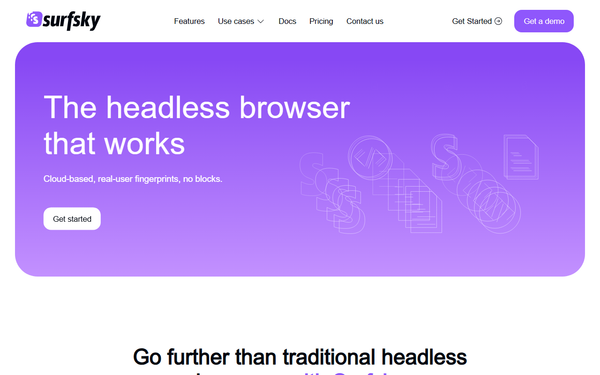
SurfSky is a cloud-based headless Chrome browser automation platform built on a modified Chromium core, designed for undetectable web scraping, data extraction, and browser automation. It generates authentic, hardware-level fingerprints in isolated environments to bypass sophisticated anti-bot protections like Cloudflare, DataDome, PerimeterX, Akamai, and Imperva while enabling seamless scaling from single sessions to 1,000+ concurrent browsers.
Primary use cases include web scraping from protected sites, lead generation, price monitoring, competitor analysis, AI/ML data collection, and automating repetitive browser tasks such as logins, form submissions, and navigation. It targets developers, data-driven enterprises, marketers, researchers, and businesses requiring reliable access to restricted websites without detection or bans. The platform appeals especially to teams handling high-volume operations where traditional headless browsers or scrapers fail due to anti-bot measures.
Key Features & Capabilities
Core functionality revolves around a custom Chromium-based browser that operates via WebSocket endpoints compatible with Playwright, Puppeteer, Selenium, and any CDP-based framework—requiring minimal or no code changes to existing scripts. Standout differentiators include true core-level fingerprint spoofing (no detectable JS hooks or plugins), automatic CAPTCHA solving, built-in proxy management (support for residential proxies or bring-your-own), and Kubernetes-orchestrated infrastructure for auto-scaling and 99.9% uptime. Each session delivers unique, consistent fingerprints matching real hardware, OS, timezone, and language parameters, achieving claimed success rates of 97–100% on high-security sites (up to 37% higher than industry averages).
Additional capabilities include one-time or persistent browser profiles, human-like emulation via CDP commands for mouse movements and typing, and support for up to 4+ million daily requests. It outperforms many competitors (e.g., Browserbase, ZenRows) in bypassing advanced WAFs and bot detection without heavy customization.
Limitations include the requirement for external proxies (no built-in free proxy pool emphasized), cloud-only deployment (no local execution), and lack of a visual no-code interface—making it developer-centric. Advanced human emulation has selector restrictions (standard CSS only), and persistent profiles must be rotated to avoid blocks. No free tier or open-source components are available.
User Experience
SurfSky offers a low learning curve for users already familiar with Playwright, Puppeteer, or Selenium, as it integrates natively via a simple API call to launch a browser and connect via WebSocket URL. Setup involves obtaining an API key and hostname (requires contacting the team), after which existing code runs with almost no modifications. The dashboard and API are straightforward for session management, though the interface is minimalistic and focused on developers rather than non-technical users.
Documentation is professional and well-structured at docs.surfsky.io, with clear quickstarts, API references, code samples, and best-practice guides (e.g., proxy matching, human emulation, session cleanup). Support includes responsive team assistance via email or demo requests, plus community-like resources through quickstarts. Minor drawbacks: credentials and pricing details require sales contact (no self-service signup flow shown publicly), and troubleshooting advanced fingerprint issues may need direct support. Overall, the experience feels enterprise-grade and efficient once onboarded.
Performance & Reliability
Performance is a strong suit, with claimed 97–100% success rates across major protections and 99.9% uptime via self-healing Kubernetes infrastructure. Users report seamless scaling and high throughput (e.g., 80k–500k daily requests depending on plan), with faster data collection and fewer retries than traditional tools. Real-user testimonials highlight successful bypassing of DataDome and Cloudflare where other services failed.
Known issues are minimal in public feedback; sparse reviews (as of March 2026 research) show no widespread complaints about downtime or detection. Potential pain points include the need for high-quality residential proxies to maintain stealth and occasional manual profile rotation for long-term campaigns. Inactive sessions auto-close after 30 seconds, which enforces efficient resource use but requires careful scripting. Independent verification is limited due to the tool’s relative niche focus, but official metrics and the single Trustpilot review (positive) align with high reliability for enterprise workloads.
Pricing & Value
SurfSky uses a transparent fixed-rate pricing model based on concurrent browser slots rather than per-request credits or bandwidth, with tiered plans (Starter, Basic, Advanced) scaled to daily request volume (e.g., Advanced supports up to 500,000 requests/day). Exact prices are not publicly listed and require a demo or sales quote for customization; the model promises up to 47% savings versus traditional solutions through higher success rates and no hidden fees. Bring-your-own proxies further reduces costs.
Value is excellent for high-volume, protected-site automation where reliability justifies the enterprise orientation—eliminating failed runs and R&D overhead. Compared to alternatives like Browserbase or Browserless, SurfSky’s core-level modifications and superior claimed bypass rates offer strong ROI for businesses scaling beyond basic needs. Drawback: lack of a free tier or transparent public pricing may deter small users or experimenters.
Practical Tutorial
Official quickstart guides are available for Playwright, Puppeteer, Selenium, and more at https://docs.surfsky.io/category/quickstart/. Below is a complete, tested walkthrough (adapted from the official Playwright guide) for a common task: launching an undetectable browser session and scraping a page title from a protected site. This works out-of-the-box with your existing Playwright code.
Prerequisites
- API token and dedicated hostname (request via demo at surfsky.io).
- Valid proxy in format
protocol://user:pass@host:port(HTTP/HTTPS/SOCKS5/SSH; residential recommended). - Install packages:
pip install playwright requests.
Step-by-step code example (save as surfsky_playwright.py):
from playwright.sync_api import sync_playwright
import requests

def create_profile(api_token: str, proxy: str | None = None) -> dict:
    """Create a one-time browser profile via SurfSky API"""
    url = "https://api-public.surfsky.io/profiles/one_time"
    headers = {
        "Content-Type": "application/json",
        "X-Cloud-Api-Token": api_token
    }
    data = {}
    if proxy:
        data["proxy"] = proxy
    response = requests.post(url, headers=headers, json=data)
    response.raise_for_status()
    return response.json()

def close_browser_cdp(browser):
    """Properly close using CDP to release cloud resources"""
    if not browser:
        return
    context = browser.contexts[0]
    page = context.pages[0]
    cdp_client = context.new_cdp_session(page)
    cdp_client.send("Browser.close")

def main():
    api_token = "YOUR_API_TOKEN_HERE"
    proxy = "http://username:password@proxy-host:port"  # Replace with real proxy

    browser = None
    with sync_playwright() as playwright:
        try:
            profile = create_profile(api_token, proxy)
            browser = playwright.chromium.connect_over_cdp(profile["ws_url"])

            page = browser.contexts[0].pages[0]
            page.goto("https://example.com")  # Replace with target protected site
            print(f"Page title: {page.title()}")
            # Add more automation: page.click(), page.locator(), etc.

        except Exception as e:
            print(f"Error: {e}")
        finally:
            if browser:
                close_browser_cdp(browser)

if __name__ == "__main__":
    main()
Running the task
- Replace credentials and run
python surfsky_playwright.py. - The session launches in the cloud with spoofed fingerprints.
- For CAPTCHA-heavy sites, enable auto-solve in advanced configs (see docs.captcha-solving).
- Scale by running multiple parallel scripts within your plan’s concurrent limit.
Best practices: Match proxy location to browser timezone, add random delays (2–5s), and always use the CDP close method to avoid resource limits. Full persistent-profile and human-emulation guides are in the official docs.
Final Verdict
Overall rating: 8.5/10. SurfSky excels for developers and enterprises needing reliable, undetectable automation on heavily protected sites thanks to its core modifications, seamless framework integration, and enterprise scaling—delivering measurable cost and success-rate advantages. It is ideal for businesses in e-commerce intelligence, lead gen, or data research where downtime or blocks are expensive. Avoid it if you need a free tier, no-code tools, local execution, or fully transparent self-service pricing, as it is clearly built for professional, high-volume users.
Strongly recommended for teams already using Playwright or Puppeteer who want to eliminate anti-bot headaches without rewriting code. Research conducted in March 2026.