TimelyGrader Review: The Ultimate AI Grading Assistant for Faculty
Overview & Purpose

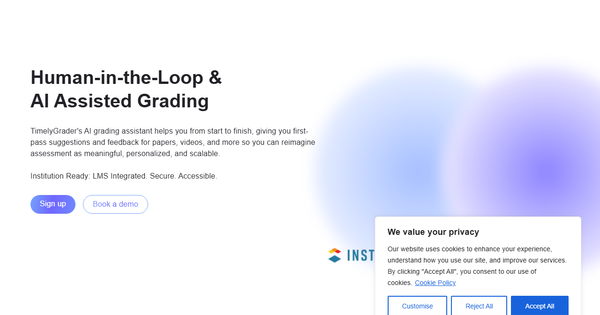
TimelyGrader is an AI-powered grading assistant designed specifically for higher education instructors and institutions. It delivers first-pass grade suggestions and personalized feedback on diverse student submissions—including written papers, videos, handwritten essays, group presentations, spreadsheets, images, charts, and more—while requiring human validation to ensure accuracy and reliability. The primary use cases include streamlining grading for large classes, enabling more frequent and detailed formative feedback without increasing workload, maintaining grading consistency across multiple graders or long sessions, and generating insights to refine teaching strategies. By integrating seamlessly with learning management systems (LMS) such as Canvas and D2L, it supports end-to-end workflows from assignment import to grade passback.
The target audience is primarily higher-education professors, lecturers, teaching assistants, deans, and institutional administrators at universities and colleges. It also extends to some K-12 contexts but is optimized for college-level assessment needs. As of March 2026, over 2,200 instructors across 1,300+ institutions have used the platform, with strong adoption at places like Arizona State University, University of Illinois Urbana-Champaign, and Dartmouth College. It is not aimed at software developers, marketers, or designers.

Key Features & Capabilities
Core functionality revolves around a human-in-the-loop AI workflow: instructors upload custom rubrics (or use the built-in AI rubric generator), import or batch-upload student submissions (up to 1,500 files), receive AI-generated grade recommendations with detailed reasoning, review and adjust suggestions, and export feedback and grades back to the LMS. The tool supports multiple rounds of personalized feedback that students can iterate on before final submission, with customizable options for tone, length, language level, and structure. Additional capabilities include consistency analytics (AI-human agreement reports), multi-grader collaboration, a content bank for improved suggestions, and support for visual/non-text elements like charts, tables, and video transcripts.
Standout features that differentiate TimelyGrader from competitors (such as text-only tools or pure auto-graders like Gradescope or CoGrader) include its multi-modal analysis of complex visuals and non-essay formats, deep LMS API integration for zero-manual-work sync (assignment creation, submission pull, and grade passback), and an explicit “dartboard metaphor” human-in-the-loop approach that combines AI speed with instructor judgment for valid, reliable results—avoiding the inaccuracies of fully autonomous AI. Security and accessibility are institution-grade: SOC 2 Type II, FERPA compliant, WCAG 2.2 AA, and VPAT ready.
Limitations include the mandatory human validation step (no true “set-it-and-forget-it” auto-grading), dependency on high-quality rubrics and assignment context for optimal AI performance, and restricted LMS support (primarily Canvas and D2L). The free plan limits full batch grading, and while it handles quizzes/exams in higher tiers, it is not optimized for purely multiple-choice automation. Missing features noted in reviews include a dedicated mobile app and broader LMS compatibility (e.g., Blackboard or Moodle).

User Experience
TimelyGrader offers a clean, modern interface with excellent accessibility features, including keyboard navigation and compliance standards that make it usable for all educators. The learning curve is moderate: first-time setup of rubrics and LMS integration takes 15–30 minutes, but subsequent workflows feel seamless thanks to one-click imports and intuitive review screens where instructors simply validate or tweak AI suggestions. Batch uploads and organized feedback summaries reduce cognitive load significantly.
Documentation is robust, with a public Help Center (help.timelygrader.ai) organized into self-serve, Canvas-specific, and D2L-specific sections containing dozens of articles, plus release notes and blog resources on best practices. Video demos and quick-start guides are available directly on the site. Support scales with plans: personalized assistance in Starter and 24/7 dedicated support for institutions. Users consistently praise the intuitive flow and time savings in testimonials, with only minor mentions of initial rubric optimization requiring practice.

Performance & Reliability
Processing is fast and efficient—AI suggestions for hundreds of submissions typically appear within minutes, enabling instructors to cut grading time by 30–60% while delivering richer feedback than manual methods alone. Reliability is enhanced by the human-in-the-loop model; independent user quotes report ~90% initial AI accuracy, with final human oversight eliminating errors. The platform maintains consistency across sessions or graders and provides post-grading analytics to help instructors improve future prompts.
Known issues or complaints are minimal in public sources as of March 2026. No widespread outages or accuracy scandals appear in searches; occasional feedback mentions the need for clear assignment context to avoid generic suggestions, but this is mitigated by rubric tools and human review. Overall uptime and security compliance are strong, with no reported data breaches.
Pricing & Value
TimelyGrader uses a tiered subscription model with no credit card required to start:
- Free Plan: $0 – Full course/assignment setup, AI rubric generator, preview grading and feedback fine-tuning, customizable rubrics. Ideal for testing.
- Starter Plan: $10 per month (billed annually) or $12 monthly – Unlimited courses, unlimited bulk uploads for all assignment types, content bank, multiple graders, personalized support.
- Institution Plan: Custom pricing (contact sales) – Everything in Starter plus administrator controls, accreditation data export, instant student draft feedback, full LMS API integration, quiz/exam grading, and 24/7 dedicated support.
Value is excellent for mid-to-large classes: the time and quality gains far outweigh the low per-instructor cost, especially versus manual grading or less flexible alternatives. Compared to competitors, it offers superior multi-modal support and ethical design at a competitive price point. Free previews lower the barrier to entry, and annual billing provides clear savings.
Practical Tutorial
Official resources include the interactive demo on the homepage, Help Center articles, and blog guides. Below is a step-by-step walkthrough for a common task—grading a batch of 50 marketing-plan essays with Canvas integration (based on official capabilities, integration docs, and user-reported workflows as of March 2026). A video example of Canvas usage is available via instructor-shared Loom tutorials on LinkedIn.
- Sign up and connect LMS: Create a free account at timelygrader.ai. For Canvas users, enable the Professional Tier integration (available in paid plans). Single sign-on pulls your courses automatically.
- Create or import assignment: In TimelyGrader, import the assignment from Canvas (one-click sync of description and due date) or create manually. Upload or generate a rubric using the AI rubric generator—e.g., paste “Evaluate a 5-page marketing plan on SWOT and Porter’s Five Forces analysis, 30% strategy depth, 25% creativity.”
- Add exemplars and fine-tune (optional): Upload 1–2 sample papers with your scores to calibrate AI. Adjust feedback parameters (tone: constructive, length: detailed).
- Batch upload submissions: Pull submissions directly from Canvas or drag-and-drop up to 1,500 PDFs/docs/videos. Processing begins instantly.
- Review AI suggestions: Open the batch dashboard. AI provides per-student grade (e.g., 87/100), breakdown by rubric criteria, and personalized comments (e.g., “Strengthen Porter’s section with specific competitor data—consider adding a visual chart”). Use the side-by-side view to edit or accept suggestions.
- Finalize and return feedback: Validate as the human-in-the-loop (required for release), add any personal notes, then push grades and full feedback back to Canvas with one click. Students receive organized, actionable comments instantly or after your review.
- Analyze insights: View the class agreement report to spot patterns (e.g., common weaknesses in financial projections) and adjust future assignments.
For full visual walkthroughs and troubleshooting, visit https://help.timelygrader.ai/ or the “Our Capabilities” page. Real example: Business professors report turning a 4-hour manual grading session into under 90 minutes while improving student revision quality.
Final Verdict
TimelyGrader earns a strong 4.7/5 rating. It excels for higher-education instructors and departments handling large enrollments who want to scale meaningful, personalized feedback while maintaining academic integrity and saving significant time. Educators in business, humanities, or multi-modal courses will benefit most from its visual analysis and LMS depth. Instructors in very small classes, those preferring zero-AI workflows, or institutions without Canvas/D2L may find limited value or should explore simpler free tools.
One-sentence recommendation: If you’re ready to reimagine assessment as both scalable and deeply human, TimelyGrader is one of the most ethical and effective AI grading solutions available today.