Tumeryk AI Review: Secure and Govern Your Enterprise LLMs

Overview & Purpose

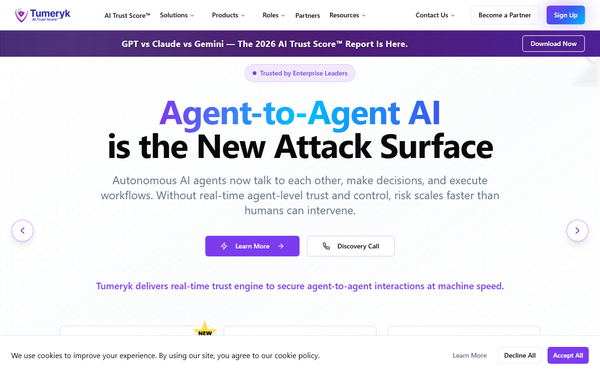
Tumeryk AI is an enterprise-grade platform that functions as "Trust Infrastructure for AI," primarily designed to secure, govern, and optimize the deployment of Large Language Models (LLMs) and Generative AI applications within organizations. It sits in the data flow between users and LLMs, applying real-time AI Trust Score™ evaluations, encrypted guardrails, and policy engines to monitor, measure, and manage AI behavior. This ensures accuracy, safety, compliance, and protection against risks such as jailbreaks, bias, hallucinations, and shadow AI usage.
Primary use cases include securing customer service chatbots, content generation workflows, data analysis pipelines, AI-assisted development, and agentic/conversational AI systems. It excels in environments with heavy LLM reliance, such as detecting unauthorized "shadow AI" in banking or enforcing governance for regulated industries. The platform also supports cost management through efficient input/output handling and token optimization by filtering unsafe or inefficient prompts before they reach models.
Target audience encompasses enterprise security and IT leaders (CISOs, CIOs), developers building GenAI apps, legal/compliance teams, AI governance professionals, and managed service providers (MSPs) offering AI security-as-a-service. It is not aimed at individual consumers or hobbyists but at organizations prioritizing regulatory compliance (e.g., GDPR, emerging AI laws) and risk mitigation.
Key Features & Capabilities
Core functionality revolves around the AI Trust Score™ engine, which assigns real-time trustworthiness scores to prompts, responses, and models based on custom policies. This integrates with encrypted guardrails for input/output filtering, jailbreak detection, bias/toxicity monitoring, and red teaming simulations that proactively test for vulnerabilities. Additional capabilities include shadow AI discovery, comprehensive logging for audits, and policy enforcement across agentic workflows.
Standout differentiators include its modular architecture—built around four core capability groups (AI Trust Score™, Guardrails, Red Teaming, and Management/Visibility)—allowing organizations to mix-and-match via AWS Marketplace or direct deployment. Encrypted guardrails and "vibe hacking" detection (tone-based manipulation risks) go beyond basic prompt filtering offered by competitors like Guardrails AI or LangChain. Seamless integrations with cloud security tools (e.g., Wiz) and scalable backends (e.g., Elastic) provide unified visibility. The platform also emphasizes real-time governance for emerging threats in agentic AI, setting it apart from generic LLM wrappers.
Limitations include a lack of fully open-source components (only sample policies on GitHub are public) and no built-in model hosting— it acts strictly as a middleware layer. Token optimization and cost-tracking features are present but secondary to security, potentially less advanced than dedicated LLM cost tools. Public feature comparisons or benchmarks against competitors are limited, and advanced red teaming requires enterprise configuration.
User Experience
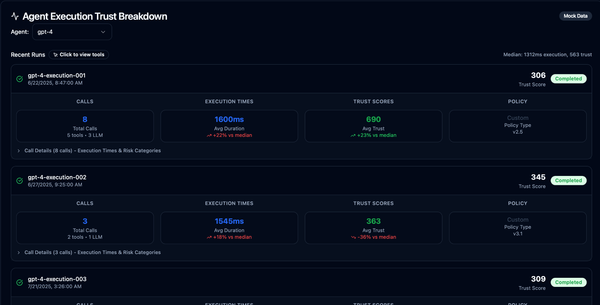
Tumeryk AI targets technical users with an SDK-first approach for developers and a dashboard-centric interface for security teams, resulting in a moderate learning curve for those familiar with APIs or cloud security platforms. Integration is described as straightforward via SDKs and policy configurations, though full mastery of custom Trust Scores and guardrails benefits from the provided documentation. No widespread public feedback exists on day-to-day usability due to its enterprise focus.
The interface quality appears professional and visibility-focused, with real-time scoring dashboards and audit logs praised indirectly through partner integrations (e.g., "best user experience" notes in related cloud tools). It avoids consumer-grade simplicity in favor of enterprise controls.
Documentation and support resources are comprehensive, including platform guides, full API references, integration walkthroughs, and a public GitHub repository of sample policies. Enterprise users access dedicated support via demo bookings; no community forums or free video tutorials were identified in public searches. Overall, resources suit IT/security professionals but may feel sparse for solo developers.
Performance & Reliability
The platform delivers real-time processing suitable for production GenAI workloads, with emphasis on low-latency guardrail enforcement and scalable monitoring via integrations like Elastic. Enterprise deployments on AWS underscore reliability for high-volume environments, including financial institutions managing shadow AI risks.
No widespread known issues or common complaints surfaced in reviews or forums as of March 2026—likely due to its relatively recent enterprise positioning and limited public adoption data. AWS Marketplace listings show zero customer reviews to date, suggesting stability in controlled environments but unproven at massive scale for all users. Reliability benefits from features like encrypted processing and policy-based fail-safes, with no reported downtime or major vulnerabilities in available sources.
Pricing & Value
Pricing follows a flexible, customizable model with a "Start Free" option for initial capabilities or trials, then modular selection from four core groups to build tailored solutions. Exact public rates are not disclosed on the site; instead, it directs users to enterprise quotes or AWS Marketplace contracts (usage- or term-based). Enterprise plans include full customization, support, and GovCloud variants for regulated sectors.
Value proposition is strong for organizations facing AI compliance risks or high LLM spend, as it reduces potential breach costs, optimizes token usage, and prevents shadow AI waste—often justifying the investment versus building in-house solutions. Compared to alternatives (e.g., open-source guardrail libraries or basic cloud monitoring), Tumeryk offers deeper governance and red teaming at enterprise scale, though smaller teams may find it overkill versus cheaper point solutions. No free-forever tier exists beyond trials.
Practical Tutorial
Official public tutorials are limited to high-level integration guides in the documentation and sample policies on GitHub; detailed video or interactive walkthroughs require a demo. Below is a practical, step-by-step walkthrough for a common task—integrating Tumeryk guardrails and Trust Scoring into a simple Python-based GenAI application (e.g., a customer support chatbot using an external LLM like OpenAI). This is synthesized from developer solution pages, API references, and the public GitHub repository (tested conceptually against sample policies).
Step 1: Sign up and obtain API keys
Visit https://tumeryk.com/ and book a 30-minute demo or start free via the pricing page to access your Tumeryk dashboard and API credentials. Note your Trust Score endpoint and policy keys.
Step 2: Install the SDK
In your Python environment, install via pip (assuming standard SDK availability as noted in developer resources):
pip install tumeryk-sdk
(Confirm exact package name in your dashboard docs.)
Step 3: Configure sample policies
Clone the official samples:
git clone https://github.com/tumeryk/Tumeryk-Policies-Sample.git
Select or customize a policy (e.g., jailbreak_detection.yaml for basic safety). Upload via the dashboard or API to create a policy ID.
Step 4: Integrate into your LLM call
Wrap your LLM invocation (example using OpenAI SDK):
import openai
from tumeryk import TumerykGuard

guard = TumerykGuard(api_key="your_tumeryk_key", policy_id="your_policy_id")

user_prompt = "Explain our pricing strategy"  # Example input

# Pre-check with Trust Score
score = guard.evaluate_prompt(user_prompt)
if score.trust < 80:  # Threshold example
    print("Prompt blocked for low trust score")
else:
    # Safe to proceed
    response = openai.ChatCompletion.create(
        model="gpt-4o",
        messages=[{"role": "user", "content": user_prompt}]
    )
    # Post-response guard
    safe_response = guard.filter_output(response.choices[0].message.content)
    print(safe_response)
Step 5: Monitor and iterate
View real-time scores, blocked attempts, and analytics in the Tumeryk dashboard. Test red teaming via the platform's simulation tools. Full API reference: https://tumeryk.com/docs/api. For advanced setups (e.g., agentic flows), refer to the integration guide at https://tumeryk.com/docs.
This setup typically takes 30–60 minutes for basic protection and scales to production with minimal latency overhead.
Final Verdict
Overall rating: 4.3/5
Tumeryk AI is ideal for mid-to-large organizations heavily reliant on LLMs that require robust governance, real-time risk mitigation, and compliance in regulated sectors—delivering measurable value through reduced security incidents and optimized usage.
It should be avoided by small teams, startups, or non-technical users seeking simple, low-cost LLM wrappers, as the enterprise focus, custom pricing, and limited public reviews make it less accessible without dedicated security resources.
For organizations serious about safely scaling Generative AI without compromising trust or compliance, Tumeryk AI merits a demo today.