Twin AI Review: The Ultimate No-Code Tool for Document Automation
Overview & Purpose
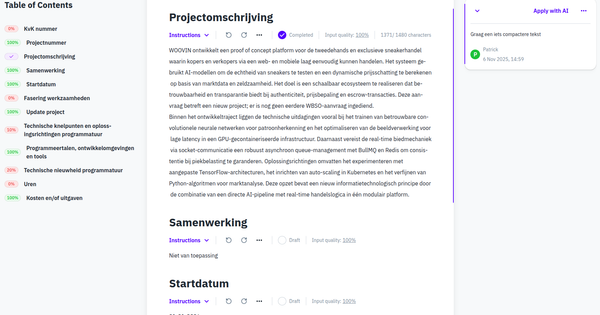
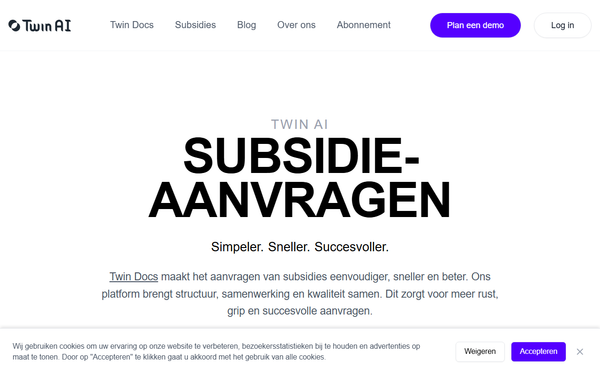
Twin AI, accessible at https://www.twinai.nl/, is a no-code AI automation platform designed to help businesses build, test, and run intelligent workflows without coding. It excels at processing large volumes of unstructured information through document analysis, contract comparison, data summarization, categorization, outlier detection, sentiment analysis, forecasting, automated form generation, image creation, customizable content generation, and advanced website scraping. Its flagship application, Twin Docs, specializes in subsidy and grant applications (such as WBSO or Horizon Europe in the Netherlands and EU), automatically structuring inputs, generating drafts, enabling real-time collaboration, and applying AI validation for error-free submissions—claiming up to 80% time savings and higher success rates.
Primary use cases include streamlining repetitive document-centric tasks, ensuring compliance in regulated processes, extracting actionable insights from data, and automating content or research workflows. The target audience spans non-technical professionals such as subsidy consultants, grant writers, operations teams, marketers, researchers, and corporate departments in education, innovation funding, and professional services. It particularly appeals to SMEs and bureaus seeking an “AI colleague” for efficiency without developers or complex setups. Research conducted as of March 2026.
Key Features & Capabilities
Core functionality revolves around a visual drag-and-drop workflow builder with reusable blocks for data ingestion (documents, web sources), AI processing (generation, analysis, comparison), validation, collaboration, and output (exports, forms, images). Users configure custom tones, connect LLMs flexibly (including custom models), set up self-learning insights, and manage AI budgets for usage tracking. Twin Docs adds specialized automation for grant applications: upload → auto-structure → draft → collaborative revision → validated submission.
Standout features differentiating it from general no-code tools (e.g., Zapier or Make.com) include deep document intelligence with context-aware precision, inconsistency/outlier detection, compliance-focused validation tailored for regulated fields like subsidies, and secure team collaboration with role-based access. It also supports advanced scraping and image generation while remaining LLM-agnostic for flexibility.
Limitations include dependency on input data quality and AI accuracy (requiring human oversight for nuanced cases), potential complexity when building advanced custom workflows despite the no-code claim, and a marketing emphasis on the subsidy niche that may obscure broader automation use cases. No extensive pre-built templates for non-document tasks were prominently documented, and public integrations appear focused on basic data sources and systems rather than a vast marketplace.
User Experience
Twin AI offers a low learning curve for non-technical users thanks to its intuitive visual interface of connected blocks and lines, making workflow construction feel like diagramming rather than programming. Basic tasks such as uploading documents or starting a Twin Docs project are straightforward, while sophisticated automations may require initial experimentation with prompts and validation rules. Interface quality is described as clean, modern, and collaborative, with real-time editing suited for teams.
Documentation consists of a knowledge base at support.twinai.nl covering account management, integrations, invoicing, and quickstart guides for workflows and member collaboration. Support resources include demo booking, direct phone/email contact (e.g., +31 6 130 92 116), and higher-tier on-call assistance. Independent user feedback is limited, but official testimonials highlight reduced stress and administrative burden. Overall, the platform prioritizes accessibility for business users over deep technical documentation.
Performance & Reliability
Performance is positioned around significant efficiency gains—users report 80% time savings on document-heavy processes and 10x faster application drafting in Twin Docs scenarios. AI validation and structure generation execute quickly, with built-in usage tracking preventing budget overruns. Reliability benefits from secure, compliant design tailored for sensitive grant and corporate data, including data sub-processors and privacy controls. No widespread user-reported outages or major issues appear in public sources as of March 2026; common AI-related caveats (occasional hallucinations or context misinterpretation) are mitigated by iterative collaboration and human review steps. The platform’s self-learning capabilities further improve accuracy over time for repeated workflows.
Pricing & Value
Pricing follows a subscription model with flexible plans centered on workflows, AI credit budgets, users, and storage. According to listings, the Starter plan starts at approximately €350/month (3 workflows, €50 AI budget, 1 user, basic features), while the Pro plan is around €650/month (10 workflows, €125 AI budget, 5 users, advanced support, 5GB storage). Enterprise options are available for custom needs. A minimum AI budget applies (starting ~€5), with usage-based tracking; no public free tier exists, though demo access is free. Higher plans unlock on-call support and expanded storage.
Value is strong for organizations with high-volume document or grant workloads, where time savings and error reduction deliver clear ROI compared to manual processes or fragmented tools (e.g., ChatGPT + spreadsheets). It competes well against broader automation platforms by combining no-code ease with specialized intelligence, though the entry cost may feel high for very small teams or occasional users. Transparent budgeting helps control expenses effectively.
Practical Tutorial
No fully public video tutorials are available, but the platform’s knowledge base and “how it works” sections on the site provide clear guidance. Below is a step-by-step walkthrough for a common real-world task—creating and validating a WBSO subsidy application using Twin Docs (the most prominently featured use case). This mirrors the official process described on twinai.nl and can be adapted to general document workflows.
- Get started: Visit https://www.twinai.nl/ and book a free 30-minute demo or sign up via the platform (contact [email protected] for access). Log in to the dashboard.
- Create a new project: Select “New Document” or “Twin Docs Project” and choose the subsidy scheme (e.g., WBSO R&D tax credit).
- Upload inputs: Drag and drop all relevant documents, emails, project descriptions, and data files into the central repository. The platform automatically ingests and organizes unstructured information.
- Generate structure and draft: Trigger the AI builder—it auto-creates the correct application template, sections, and initial content based on scheme requirements and your inputs.
- Review, collaborate, and refine: Invite team members (via the member management tool). Edit sections collaboratively; provide feedback or specific instructions (e.g., “use formal tone and emphasize innovation impact”) for the AI to revise in real time. Use built-in validation to flag inconsistencies or missing compliance elements.
- Validate and finalize: Run AI-driven quality checks for errors, completeness, and regulatory alignment. Iterate as needed.
- Export or submit: Download the polished PDF/application or integrate with submission portals. Track usage against your AI budget.
For general automation (e.g., contract comparison or data summarization), replace step 2 with “New Workflow” and add blocks for scraping/analysis. Official quickstarts are in the support knowledge base; start with a demo at https://www.twinai.nl/plan-een-demo for hands-on guidance.
Final Verdict
Twin AI earns a 4.3 out of 5 rating. It shines for teams handling complex, document-intensive processes—especially subsidy consultants, grant writers, researchers, and operations professionals in the Netherlands and EU—thanks to its specialized Twin Docs intelligence, intuitive no-code builder, and measurable time savings. Organizations needing secure, collaborative AI automation without developers will find excellent value.
Avoid it if you are a solo user or small team on a tight budget seeking free/open-source alternatives, require extensively reviewed enterprise software with vast template libraries, or have needs outside document and compliance workflows where simpler tools suffice.
Twin AI stands out as an efficient no-code solution for AI-powered document workflows and automation, ideal for organizations tackling complex content and data tasks like subsidy applications.