Uthana Review: Transform Text and Video into 3D Motion Fast
Overview & Purpose

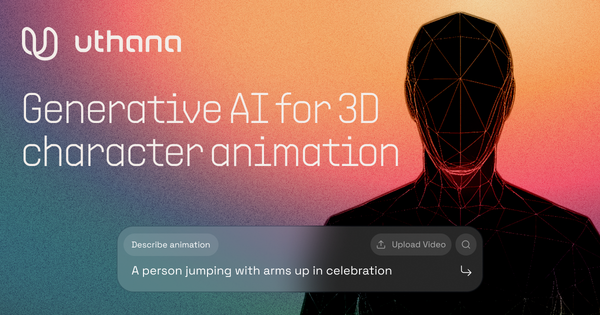
Uthana is a web-based generative AI platform specializing in human motion for 3D characters. It transforms simple text prompts, reference videos, real-time controls, or combinations thereof into production-ready animations that can be instantly applied to any character model. Primary use cases include rapid prototyping of character movements for video games, film and animation pipelines, robotics simulations, marketing content, educational visuals, and real-time interactive experiences—tasks that traditionally require hours of manual keyframing, motion capture sessions, or cleanup.
The platform targets a wide audience: independent and professional animators seeking to accelerate repetitive work, game developers building diverse locomotion and interactions, animation/film studios unifying team styles and scaling output, content creators and marketers producing quick explainer or social media assets, educators visualizing concepts, and even tech partners integrating via API for custom applications. By handling the mechanical side of motion generation, Uthana acts as a creative multiplier rather than a full replacement for human artists.
Key Features & Capabilities
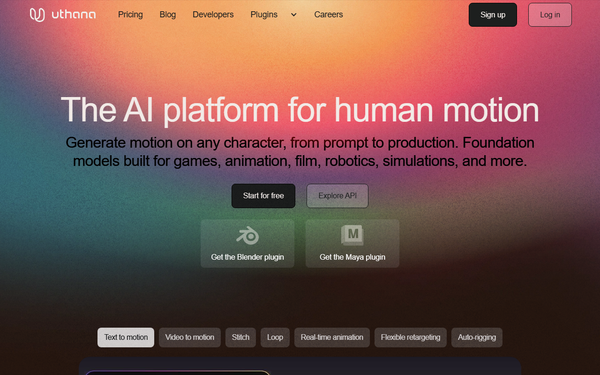
Core functionality revolves around multi-modal motion generation. Users can input text descriptions (e.g., “a warrior swinging a sword and shouting”), upload 2D videos for motion capture-style results, blend multiple clips with keyframe precision, create seamless loops, or control characters live via mouse, keyboard, or gamepad with instant recording. Auto-rigging processes unrigged models in under 60 seconds, while proprietary inverse kinematics (IK) retargeting applies motions flawlessly to any skeleton structure or rig—regardless of proportions or joint hierarchy.
Standout differentiators include biomechanically accurate, physics-aware outputs trained on massive motion-capture datasets; a built-in library of over 100,000 studio-quality motions (including finger data); real-time inference with millisecond latency and minimal memory footprint (<20 MB for game transitions); and universal compatibility across engines. Exports support FBX and GLB formats (BVH on request), with seamless integration into Unity, Unreal Engine, Maya, Blender, and more via plugins (Blender/Maya available) and GraphQL API/SDK. Upcoming enterprise features like style transfer let teams apply consistent game aesthetics across models.
Limitations include a primary focus on realistic bipedal humanoid characters (non-human or heavily stylized rigs may require manual tweaks); some advanced blending and emotional nuance still benefits from human refinement; and tiered download limits that restrict heavy commercial use on lower plans. Certain capabilities (full style transfer, expanded SDKs) remain in active development as of March 2026.

User Experience
Uthana’s browser-based interface is clean, intuitive, and designed for minimal friction—often described as “texting-level” simplicity. New users sign up, select stock characters (such as Unreal’s Manny/Quinn or custom avatars like Tar or Ava), upload their own FBX/GLB model, enter a prompt or video, and watch motions generate and preview instantly in a built-in 3D viewer. Refinement tools include sliders for speed, rotation tweaks, segment trimming, and stitching—eliminating the steep learning curve of traditional DCC software.
Documentation is solid: a comprehensive FAQ covers workflows and troubleshooting, while detailed API docs and quickstart guides enable programmatic use. Community support via Discord and email/Discord priority for paid users round out resources. The learning curve is low for anyone familiar with basic 3D concepts; even beginners can produce usable results in minutes. Minor past complaints about processing notifications (e.g., email-only updates) appear resolved in the current web app, though non-standard rigs can occasionally trigger preview issues requiring quick support contact.
Performance & Reliability
Generation typically completes in seconds rather than hours, with real-time preview and recording delivering fluid, anatomically sound results that feel production-ready out of the box. Inverse kinematics and physics awareness minimize foot-sliding or unnatural artifacts common in older tools. Reliability is high for standard humanoid pipelines, backed by large-scale training data and low-latency inference suitable for live game deployment or rapid iteration.
Known issues are minor and context-specific: occasional poses may appear slightly unnatural in complex multi-action prompts, and highly stylized or non-humanoid characters can need post-adjustments. User reviews and comparisons note no widespread outages or major reliability complaints; the platform has scaled successfully since its 2025 open beta launch. Cloud-based operation ensures consistent performance without local hardware demands, though internet connectivity is required.
Pricing & Value
Uthana offers a generous free Dreamer tier with unlimited motion generation (text, video, stitching, real-time recording), 10 character uploads/auto-rigs per month, access to the 100,000+ motion library, and 30 seconds of downloadable motion (non-commercial Creative Commons license). Paid plans (all “coming soon” with waitlist as of March 2026) scale upward:
- Student ($10/month): 75 seconds download, 50 character uploads, auto-rigging, basic support.
- Starter ($16/month): 150 seconds, 125 uploads, commercial license.
- Pro ($50/month): 500 seconds, 400 uploads, priority support.
- Higher tiers (Builder $160, Platform $660) and custom Enterprise (contact sales) add team accounts, data siloing, custom model training, SLA guarantees, and massive volume scaling.
Value is exceptional compared to traditional animation (where 20 seconds can cost $500–$5,000 in freelancer fees) or competing mocap/AI tools requiring hardware or complex setup. The free tier alone enables meaningful experimentation and pre-visualization, while paid plans deliver commercial rights and pipeline integration at a fraction of manual labor costs—ideal for indies and studios seeking to reduce timelines and budgets dramatically.
Practical Tutorial
Official documentation provides clear guidance via the FAQ and API section. Here is a complete step-by-step walkthrough for a common task—generating and exporting a custom text-to-motion animation—using the Web UI (available at https://uthana.com/app). This mirrors the official quickstart flow and uses a real-world example.
-
Create a free account: Visit https://uthana.com/user/signup, sign up with email (instant access to Dreamer plan).
-
Upload or select a character: Log into the app. Choose a stock model (e.g., Manny) or upload your own FBX/GLB file in T-pose or A-pose with feet planted. If unrigged, Uthana auto-rigs automatically (30–60 seconds).
-
Generate motion from text: Select “Text-to-Motion.” Enter a prompt such as “a warrior running forward, jumping over a log, then swinging a sword while shouting aggressively.” Adjust optional parameters (style intensity, speed, or combine with a short video reference for hybrid control).
-
Preview and refine: The motion appears instantly in the browser 3D viewer. Play it back, trim segments, adjust arm swing via sliders, or stitch in a looping idle animation from the library. Use real-time controls (WASD keys or gamepad) to record additional locomotion if needed.
-
Stitch, loop, or retarget: Blend multiple clips (e.g., add a victory pose at the end) with keyframe snapping. The proprietary IK automatically retargets to your custom skeleton.
-
Export: Download as GLB (for web/Unity) or FBX (for Maya/Unreal). Total time: under 2 minutes for a polished 10-second sequence.
For API users, the GraphQL endpoint at https://uthana.com/graphql allows the same workflow programmatically (see full docs at https://uthana.com/docs/api/). Official FAQ and capability tutorials expand on video-to-motion, real-time recording, and advanced stitching.
Final Verdict
Uthana earns a strong 4.5/5 rating for its groundbreaking speed, universal retargeting, and accessible interface that genuinely compresses weeks of animation work into minutes.
It is ideal for game developers, indie animators, studios, and content creators who need fast, lifelike humanoid motion at scale and want to integrate seamlessly with existing pipelines—especially those already using Unity, Unreal, or Blender. Users benefit most when supplementing AI output with light human polish for storytelling nuance.
Avoid it if your projects center on non-humanoid creatures, require fully offline/local processing, or demand ultra-subtle emotional performances without any iteration budget, as humanoid focus and cloud dependency may not fit.
Highly recommended as a must-try tool for anyone tired of traditional animation bottlenecks—start with the free tier today and watch your productivity soar.