Versuno AI Review: The GitHub for Prompt Engineering and Management
Overview & Purpose

Versuno AI is a prompt development and management platform that centralizes the creation, versioning, testing, optimization, and sharing of AI assets—including prompts, personas, contexts, and system prompts—within a single searchable workspace. It solves the widespread problem of scattered prompt storage across tools like Notion, code repos, Slack, or chat histories by treating prompts as production-grade assets that follow structured software engineering practices. Core activities include building reusable components, tracking every change, running side-by-side evaluations across models, and promoting assets through defined lifecycle stages before deployment.
Primary use cases revolve around prompt engineering workflows, iterative AI feature development, quality assurance for LLM outputs, and team knowledge sharing in AI-powered products. Whether optimizing customer-support agents, refining creative generation pipelines, or standardizing internal tools, Versuno enables data-driven decisions and reduces regressions from untracked changes.
The target audience includes prompt engineers, AI developers, product teams at startups and AI-first companies, founders building AI features, and independent builders. It is particularly valuable for technical users who already apply version control and testing to code but need the same discipline for prompts. It is less ideal for purely non-technical marketers or designers who may prefer simpler prompt marketplaces or chat-based tools.
Key Features & Capabilities
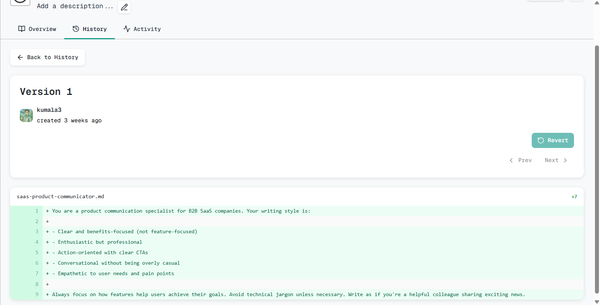
Core functionality centers on an asset-centric architecture where prompts are composed from reusable, versioned blocks (personas, contexts, system instructions) rather than duplicated text. Every asset automatically tracks full change history with inline diffs, author notes, timestamps, and one-click rollback. Assets progress through explicit states—Draft, Testing, Reviewed, Ready to Ship—providing visibility into production readiness. A built-in Testing Playground allows side-by-side execution across 50+ leading models from providers including OpenAI, Anthropic, Google, and others, complete with quality scoring and actionable feedback. Additional AI-powered tools deliver automatic improvements, optimizations, and evaluations (limited per plan). A community AI Assets Hub lets users discover, fork, and share public prompts and components across domains, while projects organize related assets for larger initiatives.
Standout differentiators include GitHub-style versioning specifically tailored for prompts (rare among competitors), structured composition that eliminates duplication, and pre-production validation with multi-model comparison and automated scoring—features that go beyond basic prompt libraries or runtime observability tools like Langfuse or PromptLayer. The platform remains model-agnostic and portable, with strong default encryption and no vendor lock-in.
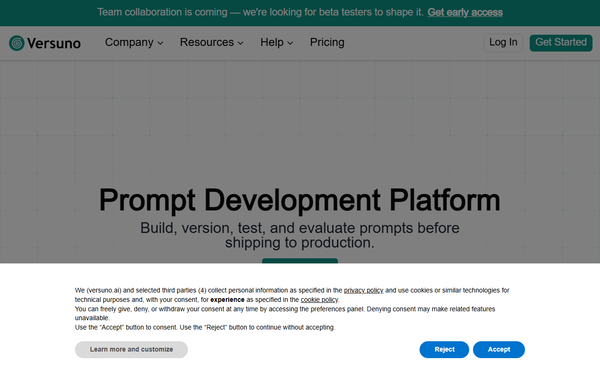
Limitations include storage caps (250 MB on Free, 500 MB on Pro), absence of full production monitoring or tracing (development-focused only), and team collaboration features still in beta. Integrations beyond the testing playground are minimal, and advanced enterprise SSO or audit logs are not yet detailed. Public assets are unlimited, but heavy private usage quickly pushes users toward paid tiers.
User Experience
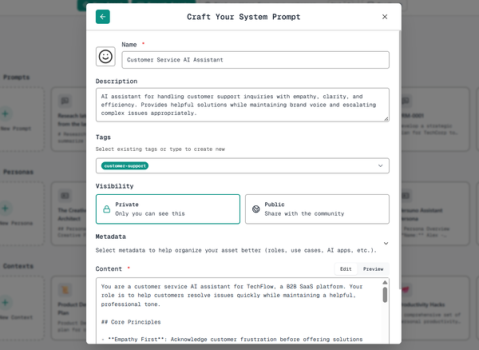
Versuno offers a clean, modern web dashboard with sidebar navigation, searchable asset library, and intuitive editors for composing blocks. Users familiar with Git or Notion report a gentle learning curve; the structured workflow feels natural after 10–15 minutes of exploration. Interface quality is professional and focused—no clutter, with clear visual diffs and side-by-side model outputs in the playground. Mobile access is limited (web-primary), but responsive design works well on tablets for quick reviews.
Documentation and support resources include a Help Center with self-serve guides, feature tutorials, FAQs, and best practices; email support (responses typically under 24 hours); and an active Discord community for instant peer help. A concise “Versuno in 100 seconds” overview video on YouTube provides an excellent quick-start. No extensive public user forums or video course library exists yet, but the help resources cover core tasks adequately. Overall, the experience feels polished for an early-stage tool, with interactive demos on the homepage accelerating onboarding.
Performance & Reliability
The platform performs efficiently for its intended development use: multi-model testing completes in seconds to minutes depending on chosen providers, version history loads instantly, and AI-powered suggestions respond quickly. No latency complaints or outages appear in available sources as of March 2026. Assets are encrypted in transit and at rest, with clear versioning preventing silent regressions.
Known issues or common complaints are virtually nonexistent in public forums, directories, or social mentions—likely because the tool launched around late 2025 and remains niche. Early adopters on Reddit and X note smooth operation and praise the “easy to use” workspace. Reliability appears solid for individual and small-team workflows, though users on free tier may occasionally hit AI feature limits during heavy testing sessions.
Pricing & Value
Versuno follows a transparent freemium model with monthly or yearly billing (yearly saves the equivalent of two months). No credit card is required to start.
- Free: $0/month — unlimited public assets, 10 private assets, 10 projects, 10 AI-powered improvements/optimizations/evaluations per month, limited testing playground access, 250 MB storage, up to 4 team members (basic support).
- Pro: $15/month — unlimited private assets and projects, 150 AI-powered uses per month, unlimited testing playground (including pro models), 500 MB storage, priority support.
- Team: Pricing on request via early-access contact form — collaboration features forthcoming.
Value is strong for individual prompt engineers and small AI teams: the Pro tier at $15 delivers Git-level versioning and robust multi-model testing that would otherwise require custom scripts or multiple tools. Compared to alternatives (e.g., general prompt libraries or observability platforms), Versuno’s combination of composition, lifecycle management, and pre-production validation offers superior workflow discipline at a competitive price. Free tier suffices for experimentation or light personal use but quickly limits serious projects.
Practical Tutorial
Official documentation is lightweight, but a clear walkthrough exists via the “Versuno in 100 seconds” video (https://www.youtube.com/watch?v=oTJe5QkiESY) and Help Center. Below is a practical, real-world step-by-step for a common task: creating, versioning, and testing a customer-support prompt asset (tested March 2026).
-
Sign up and create a project — Visit versuno.ai, click “Start Free Today,” and create an account (Google or email). On the dashboard, click “New Project,” name it “Customer Support Agent,” and add a description.
-
Build reusable components — Navigate to Assets > New Asset. Create a “Persona” asset titled “Empathetic Support Rep” with traits (e.g., “friendly, concise, always offers escalation path”). Create a “Context” asset with product details or knowledge base snippets. Create a “System Prompt” asset with guardrails (tone, length, compliance rules).
-
Compose the main prompt — Click “New Prompt,” name it “Refund Inquiry Handler.” In the composer, drag in the Persona, Context, and System blocks, then add the user message template: “User says: {query}. Respond according to policy.” Save as version 1.0 with note “Initial draft.”
-
Version and document — Make an edit (e.g., tighten response length). Save as version 1.1; the platform auto-generates an inline diff highlighting changes and records “who/when/why.” Rollback is one click if needed.
-
Test in the Playground — Open the prompt, click “Test in Playground.” Select 3–5 models (e.g., GPT-4o, Claude-3.5-Sonnet, Gemini-1.5-Pro). Paste 3–5 test queries (e.g., “I want a refund for a defective item”). Run side-by-side; review outputs, quality scores, and AI-generated feedback on coherence, policy adherence, and empathy.
-
Optimize and evaluate — Click “AI-Powered Optimization” (uses one monthly credit). Accept suggested refinements, then run “Evaluation” for automated scoring. Update the asset state to “Testing” or “Reviewed.”
-
Share or promote — Mark as “Ready to Ship,” copy the production version, or share the public link via the community hub. For teams (beta), invite collaborators directly.
Repeat for related assets; everything stays searchable and linked within the project. Full visual demo available in the official 100-second video.
Final Verdict
Overall rating: 4.2 out of 5 (strong concept and execution for an emerging tool; docked slightly for nascent team features and limited public long-term reviews).
Prompt engineers, AI developers, and product teams frustrated with chaotic prompt management should use Versuno—it delivers the missing Git-style discipline, reusable composition, and rigorous multi-model testing that turns prompts into reliable production assets. Casual hobbyists or teams needing full collaboration and advanced observability right now should avoid it until the Team plan matures and storage expands.
Versuno AI is the closest thing yet to “GitHub for prompts”—start free and upgrade when your AI assets demand professional rigor.