Wand AI Review: The Ultimate OS for Scaling AI Workforces

Overview & Purpose

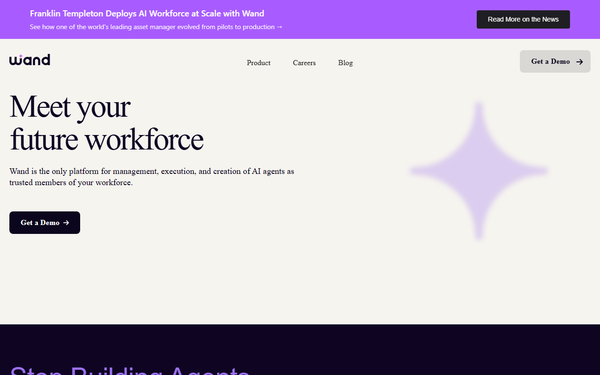
Wand.ai is the complete operating system for hybrid human-AI workforces, enabling organizations to build, manage, execute, and scale dynamic teams of self-evolving AI agents alongside human employees. It leverages multi-agent orchestration and a cognitive layer to interpret natural language queries, automate workflows, integrate enterprise systems, and deliver actionable outcomes with built-in transparency and governance. Primary use cases include end-to-end process automation (e.g., data analysis, reporting, and forecasting), division-level scaling where agents autonomously handle entire functions, and real-time collaboration between humans and agents for complex, cross-departmental tasks. It has been deployed at scale by major enterprises, such as Franklin Templeton in asset management for evolving AI pilots into production workflows across research and operations.
The target audience consists mainly of enterprises, large organizations, and knowledge workers in knowledge-intensive sectors like finance, operations, and professional services. It is designed for business leaders and teams seeking to deploy advanced AI without deep technical expertise, focusing on scalability, control, and ethical integration rather than individual consumer or small-team use.
Key Features & Capabilities
Core functionality revolves around three pillars: Manage (centralized control panel for monitoring agent performance, costs, benchmarks, and autonomy settings), Execute (unified command center for natural-language-triggered multi-agent/multi-human workflows, real-time collaboration, and process automation), and Create (autonomous or manual agent assembly with guardrails on budgets, objectives, and escalation). Agents are self-evolving—they benchmark outcomes, retrain or replace themselves, learn business context, and escalate edge cases to humans while continuously improving.
Standout features include patented Artificial Workforce Technology for governed autonomy (agents remain budget-positive and compliant), enterprise-grade data connectivity across silos, full visibility dashboards, and human-first design with shared chat workspaces. These differentiate Wand.ai from single-agent builders or reactive tools by treating agents as adaptive workforce members that scale from 1:1 collaboration to fully autonomous divisions (e.g., 1:1000 ratios). Security features like SOC2 readiness and flexible deployment (on-premise, private cloud, or hosted) add enterprise appeal.
Limitations include a focus on complex, large-scale implementations, which can make it over-complicated for simple automation tasks. Some users report challenges correcting modeling errors, and the platform lacks extensive out-of-the-box templates for very basic queries compared to consumer AI chatbots. Public feature depth for non-enterprise users remains limited.
User Experience
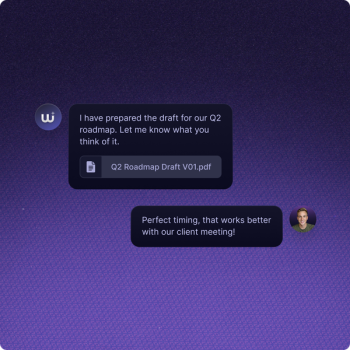
Wand.ai offers a low learning curve with an intuitive, no-code interface centered on dashboards, a command-center chat workspace, and natural-language prompting—accessible to non-technical knowledge workers. Reviews highlight the clean design and ease of initiating workflows, making AI feel like a collaborative teammate rather than a tool requiring coding.
Interface quality is modern and enterprise-focused, with real-time visibility into agent actions, costs, and escalations for full transparency. Documentation is primarily demo-driven and blog-based, with limited public user guides or self-serve resources; support comes through enterprise sales, dedicated account teams, and case-study materials. Overall, the platform excels for teams already invested in AI adoption but may feel sparse for users expecting extensive free tutorials or community forums.
Performance & Reliability
The platform delivers strong speed and efficiency through self-evolving intelligence: agents improve with every task, enabling compounding ROI and execution that scales far beyond traditional tools (e.g., automating divisions with minimal human oversight). Production deployments, such as Franklin Templeton’s expansion across global operations, demonstrate reliable real-world performance with continuous learning and human escalation handling edge cases effectively.
Known issues are minimal in public feedback due to its enterprise niche, but some reports note occasional challenges with agent consistency in highly customized modeling or initial setup complexity. No widespread outages or major complaints appear in reviews; reliability is bolstered by governance controls and visibility features. As of March 2026 research, user sentiment on G2 (approximately 3.8/5 across limited reviews) emphasizes automation strengths while acknowledging typical AI planning nuances.
Pricing & Value
Wand.ai uses a custom enterprise pricing model with no public free tier, starter plans, or fixed rates—quotes are tailored based on scale, number of agents, workflows, and deployment needs (contact sales for details). Third-party aggregators confirm customized costing without transparent per-user or usage tiers.
Value is exceptionally high for large organizations: it reduces operational costs dramatically (often to a fraction of traditional processes), accelerates decision-making, and provides measurable ROI through self-improving agents and full visibility—outpacing alternatives like custom agent frameworks or basic RPA tools for hybrid workforce scaling. Smaller teams or those needing quick, low-cost solutions may find the enterprise focus less competitive on immediate affordability.
Practical Tutorial
No fully public step-by-step tutorials or self-serve sandbox exist (the platform emphasizes personalized 30-minute demos for enterprise access). Below is a practical, real-world walkthrough for a common task—automating quarterly financial report generation and insights—based directly on Wand.ai’s documented Manage/Execute/Create pillars and Franklin Templeton-style enterprise workflows. This can be replicated after requesting a demo at https://wand.ai/.
-
Access and Setup: Request a demo via the official site (https://wand.ai/). Once onboarded (typically via hosted or private deployment), log into the dashboard and navigate to the Create section. Define a high-level goal in natural language, e.g., “Assemble agents to generate Q1 financial summary with CRM/ERP data integration, trend analysis, and executive insights.”
-
Agent Creation: The system autonomously (or with manual input) assembles specialized agents (e.g., data gatherer, analyzer, formatter). Set guardrails for budget limits, data sources, and escalation confidence thresholds. Agents automatically connect to your enterprise systems.
-
Execute the Task: Switch to the Execute command center (collaboration platform). Issue a natural-language query: “Run Q1 sales forecasting report integrating latest CRM and ERP data, highlight variances, and suggest optimizations.” Agents orchestrate in real time—pulling data, coordinating analysis, and escalating ambiguities (e.g., “Missing dataset—please confirm access”) via shared chat.
-
Monitor and Collaborate: In the Manage control panel, track live performance, costs, and progress dashboards. Provide human input or approvals in the chat workspace as needed. Agents execute the workflow end-to-end and output the report.
-
Review and Iterate: Approve the final deliverable. Agents self-benchmark outcomes, retrain on feedback, and refine future runs automatically. Return to the control panel for performance metrics and adjustments.
For official examples and video overviews of these flows, visit https://wand.ai/ or the blog case studies. Full hands-on requires enterprise access, but this mirrors documented production usage.
Final Verdict
Overall rating: 4.2/5.
Enterprises and large organizations with knowledge workers ready to scale AI as a true workforce extension should use Wand.ai for its unmatched governance, self-evolution, and hybrid collaboration—delivering production-proven results with transparency and efficiency. Avoid it if you are a small business, solo user, or need simple off-the-shelf automation, as the custom enterprise model, setup complexity, and lack of free/public resources make it overkill and less accessible.
Wand.ai stands out as the operating system that turns AI agents into reliable colleagues for ambitious organizations building the future of work.