Compare LLMs Easily with WhatLLM.org: The Ultimate Free Guide
Overview & Purpose

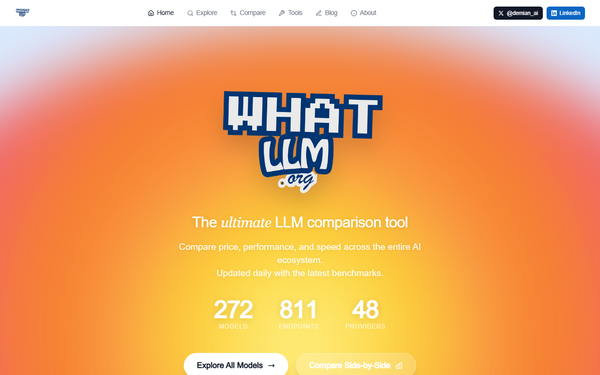
WhatLLM.org is a free, AI-driven LLM comparison platform that aggregates data on 256+ large language models across 754 endpoints and 43 providers, ranking them using the standardized Artificial Analysis Intelligence Index (a composite 0–100 Quality Index) alongside live metrics for price (input/output per million tokens), performance, speed (output tokens per second), and context window size. It pulls verified pricing and throughput directly from providers while sourcing benchmark data from Artificial Analysis, updating daily to reflect new model releases and pricing changes. The platform’s primary purpose is to eliminate fragmented research by offering unified, interactive tools for side-by-side model evaluation, enabling users to quickly identify optimal LLMs for specific workloads. Key use cases include selecting models for code generation, advanced reasoning, long-context document processing, cost-sensitive production deployments, and agentic applications. The target audience is primarily developers, product teams, AI engineers, and businesses optimizing API budgets or building production features; it is also valuable for researchers and analysts, though less relevant for non-technical roles such as pure marketers or designers unless focused on content-generation tasks.
Key Features & Capabilities
Core functionality centers on three pillars: an explorable database with advanced filters and sorting, head-to-head comparisons supporting up to four models simultaneously, and guided decision tools including the LLM Selector wizard and Provider Finder. Users can sort or filter by Quality Index, blended price, output speed, context length, or open-source status, while curated “Quick Picks” highlight best-value, fastest, or most-capable models for immediate insights. Standout differentiating features include real-time aggregation of provider-specific pricing and latency variations (e.g., the same model ranging $0.10–$0.26/M tokens and 100–3,000+ tok/s depending on the host), the question-driven LLM Selector that matches use cases like “Code Assistance” or “Research & Analysis” to ranked shortlists, and a regularly updated blog with in-depth release analyses. The platform also offers task-specific views for coding, math/reasoning, general knowledge, and long-context work. Limitations include complete reliance on third-party Artificial Analysis benchmarks (no independent testing performed by WhatLLM.org), absence of a built-in playground for live model inference, lack of exportable reports or API access, and no native support for multimodal or image-generation models. Missing features noted by users include production-scale cost calculators, historical performance trending, and enterprise collaboration tools.
User Experience
Navigation is exceptionally intuitive with a modern, responsive interface featuring sortable data tables, real-time filters, and clean side-by-side comparison layouts that load quickly even on mobile. The learning curve is minimal—developers and technical users typically become proficient within minutes thanks to self-explanatory wizards and contextual tooltips. Interface quality is professional and clutter-free, emphasizing actionable metrics over flashy visuals. Documentation consists of a comprehensive public methodology page detailing the Intelligence Index calculation, plus an active blog for practical insights; however, there are no video tutorials, extensive FAQ sections, or in-app help overlays. Support is limited to a basic contact form with no dedicated chat, knowledge base, or community forum, though the transparent sourcing and frequent updates build strong user confidence. Overall, the experience feels purpose-built for speed and clarity, earning consistent praise in niche reviews for reliability and ease.
Performance & Reliability
Page loads and interactive elements (filters, comparisons, wizard results) perform snappily as the platform is a lightweight frontend over pre-aggregated data, with no noticeable lag even when handling large model lists. Daily updates ensure pricing and major benchmark shifts appear promptly, while routine synchronization with Artificial Analysis occurs weekly. Reliability is high thanks to verified data pipelines and public methodology; no widespread outages, data inaccuracies, or common complaints appear in user discussions or reviews as of March 2026. Minor caveats include occasional short delays for brand-new model pricing (resolved within 24 hours) and the inherent variability of provider throughput, which the platform transparently displays rather than averaging. Users report the tool as a trustworthy single source of truth, free from vendor bias.
Pricing & Value
WhatLLM.org is entirely free with no tiers, subscriptions, ads, or enterprise options—users access every feature, filter, comparison, and blog post without registration. This creates exceptional value for developers and teams who would otherwise spend hours cross-referencing Artificial Analysis, provider docs, and scattered leaderboards. Compared to alternatives like the raw Artificial Analysis site (strong benchmarks but less interactive pricing aggregation), LMSYS Chatbot Arena (human votes, no pricing), or Hugging Face Open LLM Leaderboard (open models only), WhatLLM.org stands out for its practical multi-provider cost and speed views plus guided selectors, saving significant time and reducing selection errors. The value proposition is particularly strong for cost-conscious or latency-sensitive projects, where real provider variability can make or break ROI.
Practical Tutorial
No official video tutorials exist, but the platform’s self-guided tools make hands-on learning straightforward. Below is a complete walkthrough for a common task—finding the best LLM for code assistance (as of March 2026). Official entry point: https://whatllm.org/tools/llm-selector.
- Navigate to the LLM Selector at https://whatllm.org/tools/llm-selector.
- Select the primary use case: “Code Assistance (coding, debugging, developer workflows)”.
- Answer the follow-up prompts (e.g., prioritize low latency under 500 ms, budget under $0.50/M tokens, strong context window >128K). The wizard processes these against live Quality Index, price, and speed data.
- Review the generated shortlist (typically 3–5 ranked models with key metrics displayed). Example output might highlight options like Gemma 3n E4B Instruct ($0.03/M tokens, solid coding benchmarks) or a frontier model such as DeepSeek V3.2 for higher reasoning depth.
- Click any recommended model to jump to the Explore database (https://whatllm.org/explore) or directly to Compare (https://whatllm.org/compare).
- In Compare, select up to four models, then toggle views for detailed benchmarks (LiveCodeBench scores), provider pricing tables, and throughput charts.
- Optionally switch to Provider Finder for the cheapest/fastest endpoint.
- Export insights manually or bookmark the comparison for team review.
This process typically takes under five minutes and yields immediately actionable recommendations grounded in current data. For deeper understanding of scores, consult the linked methodology page.
Final Verdict
Overall rating: 4.5/5 (excellent for its niche; minor deductions for limited support and third-party data dependency). Developers, product teams, and businesses evaluating or deploying LLMs should use this tool because it delivers objective, up-to-date, multi-provider comparisons and guided recommendations that dramatically accelerate decision-making while remaining completely free. Avoid it if you require custom benchmark execution, enterprise-grade SLAs, API integrations, or in-depth multimodal analysis, as these fall outside its aggregator-focused scope. One-sentence recommendation: WhatLLM.org is the clearest, most practical dashboard available for turning overwhelming LLM options into confident, data-backed choices—bookmark it today.