Yorph AI Review: The AI Data Engineer in Your Pocket
Overview & Purpose
Yorph AI is an agentic data platform designed as a "data engineer in your pocket," enabling non-technical business users to connect multiple data sources, clean and transform data, build analytics pipelines, and generate insights through a conversational natural-language interface. It automates complex workflows like data wrangling, attribution analysis, cohort retention calculations, and semantic layer evolution using autonomous AI agents, while maintaining full human-in-the-loop oversight for approvals, visibility, and audit trails. Primary use cases include automating repetitive data preparation (e.g., joining files from Google Drive and Snowflake), running deep analyses such as identifying revenue drivers or marketing spend attribution, creating reusable pipelines for visualizations, and evolving a governed semantic layer over time for consistent metrics across teams.
It targets product managers, analysts, FP&A professionals, marketing and operations teams, business leaders, and any data-touching roles without dedicated engineering resources—especially those frustrated by SQL bottlenecks or waiting on data teams. Non-programmers benefit most, as one testimonial notes: "As a non-programmer, this unlocks analysis I wasn't really doing before."
Key Features & Capabilities
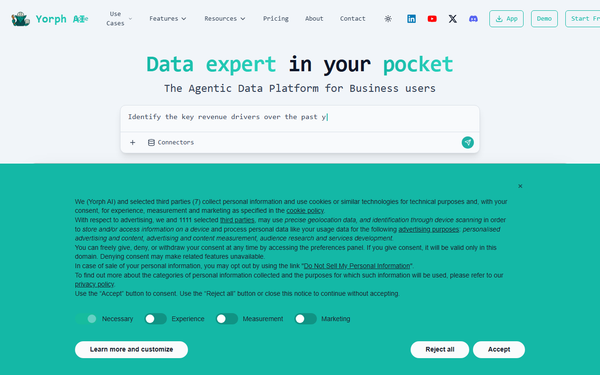
Core functionality revolves around a chat-based interface where users describe needs in plain English (e.g., "Run a full attribution analysis on our marketing spend vs. revenue"), after which AI agents autonomously plan pipelines, select transformations, execute in a sandbox, and deliver validated results with visualizations. Key capabilities include instant data connectors (Google Drive, OneDrive, Dropbox, Snowflake, BigQuery, plus direct CSV/Excel/JSON/XML uploads), step-by-step pipeline transparency with intermediate outputs, automated validation at every stage, and an adaptive semantic layer that improves accuracy, lineage, and governance organically through use.
Standout differentiators are its three tenets: Depth (handles complex tasks like full attribution or co-occurrence analysis in 2 prompts versus 20 in simpler tools), Autonomy (minimal back-and-forth with agentic planning), and Transparency & Trust (no black boxes—full audit trails, sandbox testing on sample data, and one-click production deployment). Human-in-the-loop approval ensures control, and security features keep actual data private (LLM sees only high-level statistics). It fully supports the "DAT Framework" areas of data engineering, pipelines/feature engineering, attribution/insights, and semantic layers, with partial coverage for actions/strategy.
Limitations include a still-evolving connector list (no mention of broader enterprise warehouses yet), reliance on user validation (not fully hands-off), and partial framework support in some areas. As a relatively new platform (beta launched late 2025), advanced custom scripting or extreme-scale enterprise orchestration may still require traditional tools. No native real-time streaming or advanced ML model deployment is highlighted.
User Experience
The interface is intuitive and conversational, lowering the barrier for non-technical users with plain-language prompts, visual pipeline previews, and guided refinements (e.g., "Refine to focus on digital channels only"). Onboarding has been actively improved with help sections and learning resources, contributing to a gentle learning curve—most users can connect data and run their first analysis in minutes.
Interface quality feels modern and transparent, emphasizing sandbox previews and step-by-step explainability over opaque outputs. Documentation includes Yorph University (video guides on data cleaning, transformations, semantic layers, and automation) and an official YouTube channel with demos like "Build analytics pipelines with Yorph in minutes" and "How Yorph AI helps you create a semantic layer." Support resources also cover blogs on the underlying tech and security. Community feedback on early Reddit and LinkedIn posts praises ease for business users, though independent long-term UX studies are limited due to the platform's recency.
Performance & Reliability
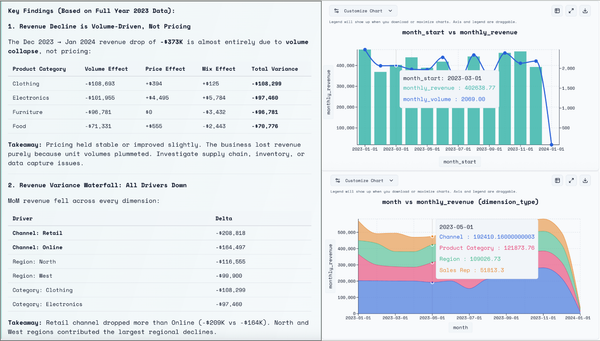
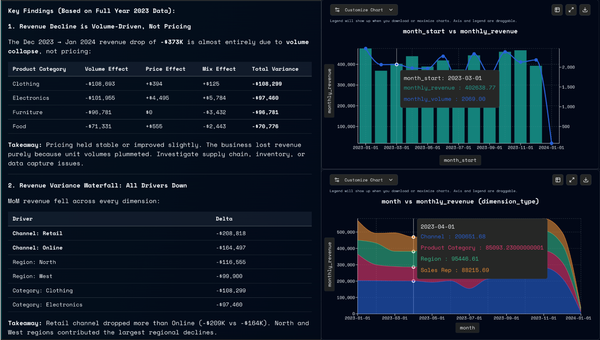
Tasks complete quickly—complex pipelines and analyses (e.g., cohort retention or revenue driver identification) are planned, validated, and visualized in minutes with minimal prompts. The sandbox environment enables confident testing on sample data before production runs, and the adaptive semantic layer improves over time for higher accuracy and fewer errors. Reliability is enhanced by automated validation, full audit trails, and workspace isolation.
As of March 2026 research, no widespread known issues or common complaints appear in public reviews on Capterra, Reddit, or tech forums; the platform's beta status means early adopters report smooth experiences for typical workflows, with no reports of downtime, data loss, or major inaccuracies. Security architecture (LLM limited to statistics only, data deleted on logout unless opted in) supports reliable enterprise-grade handling, though SOC 2 Type 2 certification remains in progress.
Pricing & Value
Yorph AI offers a Free plan to try the platform (no credit card required for basic access and testing), with paid tiers labeled Basic, Teams, and Enterprise for higher usage limits, additional connectors, advanced governance, and priority support. Exact monthly pricing is not publicly detailed online and appears to require signup or sales contact for full quotes, but the model emphasizes cost efficiency by reducing tool sprawl and headcount needs.
Value proposition shines against alternatives like Alteryx or traditional ETL tools: no-code accessibility for business users, built-in transparency, and evolving intelligence deliver faster insights at lower total ownership cost for mid-sized teams. Compared to generic AI chat tools, its agentic pipelines, sandbox, and semantic layer provide production-ready reliability without engineering overhead—ideal for organizations seeking governed analytics without dedicated data teams.
Practical Tutorial
Official resources include Yorph University (https://yorph.ai/yorph-university) with video guides on core tasks and the YouTube channel (@YorphAI) featuring walkthroughs such as "Build analytics pipelines with Yorph in minutes" and "Trend analysis and sport analytics using Yorph." Below is a self-contained step-by-step tutorial for a common task—performing a cohort retention analysis and visualization—based on real examples from the platform's documentation and demos (e.g., combining signup and activity data).
-
Sign up and connect data: Go to https://yorph.ai/, click "Start Free" or /login. Create a workspace. In the chat or connectors section, upload sample files (e.g., customer_signups.csv and user_activity.csv) or connect Google Drive/Snowflake. Confirm connection in minutes—no code required.
-
Initiate the conversation: In the main chat interface, type a natural-language prompt: "Build a cohort retention analysis: join signups with activity data, calculate months since signup, aggregate retention percentage by cohort month."
-
Review AI-generated pipeline in sandbox: Yorph's agents automatically plan steps (e.g., "Standardize data formats," "Remove outliers," "extract_signup_month," "identify_monthly_activity," "combine_cohort_and_activity," "calculate_months_since_signup," "aggregate_cohort_retention," "calculate_retention_percentage"). Inspect the step-by-step pipeline view, intermediate data outputs, and validations. Test on sample data first.
-
Refine and approve: If needed, reply: "Refine to focus on first 6 months and add visualization." Approve execution via human-in-the-loop prompt. The system runs the full pipeline.
-
Get results and iterate: Receive visualizations (charts/tables) plus insights. Export, save as reusable pipeline, or evolve the semantic layer by saying: "Add this as a governed metric for future queries." Run in production with one click for scheduled reports.
This process typically takes under 10 minutes for first-time users. For video versions, search the official YouTube channel or explore Yorph University modules on "Data cleaning, transformation, semantic layers, and workflow automation."
Final Verdict
Overall rating: 8.5/10 (strong on innovation and accessibility; docked slightly for limited public pricing transparency and beta maturity).
Teams of product managers, analysts, and business users without dedicated data engineers should use this tool to accelerate insights, automate pipelines, and maintain governance through transparent, evolving AI—especially valuable for fast-growing organizations needing explainable results without code or high costs.
Large enterprises requiring fully certified compliance today or highly customized code-heavy workflows should avoid it until SOC 2 Type 2 is complete and more connectors/scaling options mature.
Yorph AI delivers on its promise of putting a reliable data engineer in your pocket—try the free tier if you want governed, conversational analytics without the engineering wait.