YuE Review: The Best Free Open-Source Alternative to Suno AI
Overview & Purpose

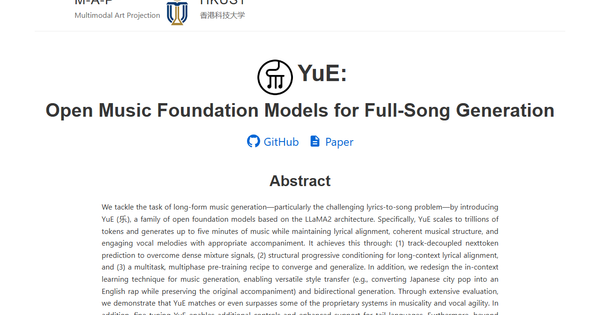
YuE (pronounced "yeah," meaning "music" and "happiness" in Chinese) is an open-source family of foundation models built on the LLaMA2 architecture, specifically engineered for transforming lyrics into complete, full-length songs with both vocals and instrumental accompaniment. It generates coherent tracks up to five minutes long, preserving lyrical alignment, musical structure, genre fidelity, and advanced vocal techniques across multiple languages and styles. Primary use cases include AI-assisted songwriting, style transfer from reference audio (e.g., turning a Japanese city pop track into an English rap while keeping the original backing), voice cloning, music understanding tasks, and creative experimentation for hobbyists or professionals. It also supports bidirectional generation and incremental continuation, making it ideal for iterative song development.
Target audience includes developers and AI enthusiasts with access to GPUs who want full control and local execution (no usage limits or data sharing), independent musicians and songwriters seeking a free alternative to proprietary tools like Suno or Udio, researchers exploring music AI (thanks to strong performance on benchmarks like MARBLE), and content creators in multilingual contexts (English, Chinese, Japanese, Korean, with code-switching). Non-technical users can access it via community interfaces, but core adoption favors those comfortable with Python or ready-to-use UIs.

Key Features & Capabilities
Core functionality revolves around lyrics-to-song generation in two stages: Stage-1 (7B-parameter models) handles coarse semantic tokens via track-decoupled next-token prediction and structural progressive conditioning (Chain-of-Thought or CoT mode), while Stage-2 (1B upsampler) refines acoustic details for 44.1kHz output. Standout features include redesigned in-context learning (ICL) for reference-song style transfer and voice cloning using 30-second vocal/instrumental audio prompts, support for diverse genres (metal, jazz, rap, K-pop, folk, etc.), vocal styles (scatting, death growl, riffs, powerful belt), and spontaneous elements like harmonica improvisation. It handles full song structures (verse, chorus, bridge, outro) and multilingual code-switching while matching or exceeding some proprietary systems in musicality and vocal agility. Additional models include specialized CoT/ ICL variants per language and a dedicated upsampler for quality enhancement.
Differentiators from competitors: Fully open-source under Apache 2.0 (commercial use allowed with attribution), local/offline execution with no restrictions, explicit long-form coherence up to 5 minutes (longest among open models), and emergent capabilities like a cappella via ICL. Fine-tuning via LoRA is supported for custom styles or tail languages.
Limitations include occasional high-vocal-range distortion in older checkpoints (improved in updates), moderate tempo/rhythm control, prompt sensitivity (lyrics often benefit from GPT rewriting), and no native real-time generation or official web app (reliant on community forks). Acoustic fidelity lags behind top proprietary mixers due to tokenizer constraints, and full 5-minute tracks require significant compute.

User Experience
Installation follows a straightforward conda/PyTorch setup (Python 3.8+, CUDA 11.8+), with git clone, requirements install, and FlashAttention-2 for long sequences—complete in under 10 minutes on Linux/WSL (Windows via Pinokio or Docker). Inference uses simple CLI scripts with text files for genre tags and structured lyrics (e.g., [verse]\n\n[chorus]), plus optional audio prompts for ICL; community Gradio UIs (YuE-UI, YuE-exllamav2) add interactive timelines, batching, and low-VRAM quantization for 8GB GPUs. Learning curve is moderate for developers (clear README examples and prompt engineering guide) but steep for absolute beginners without coding experience—mitigated by one-click installers and YouTube tutorials.
Interface quality is code-first with polished community front-ends offering preview, continuation, and session saving. Documentation is excellent: comprehensive GitHub README with prompt templates, tag lists, hardware tables, and best practices; official demo page showcases 20+ genre examples; paper provides deep technical insight. Support includes active Discord, GitHub issues, and community forks for extensions.
Performance & Reliability
Generation speed is compute-bound: ~150 seconds for 30 seconds of audio on H800 GPUs, ~360 seconds on RTX 4090; full songs take minutes to hours depending on segments and hardware. Optimizations (exllama, YuEGP) enable 6–12GB VRAM runs (slower but usable). Reliability is high for musical coherence and lyrics following in supported languages, with human evaluations showing parity or superiority to some closed models in musicality and emotion. Outputs are consistent across runs with proper prompting and classifier-free guidance.
Known issues include VRAM demands for unoptimized full models (recommend 24GB+ for comfort), occasional repetition or minor artifacts (addressed by repetition penalty and updates), and slower iteration than cloud services. User feedback on Reddit and forums praises vocal agility and openness but notes it's "not quite Suno-level polish" in subtle emotional nuance or instant gratification; no widespread crashes or instability reported as of March 2026. Incremental generation and LoRA fine-tuning have greatly improved workflow reliability.
Pricing & Value
YuE is completely free and open-source under Apache 2.0, with no tiers, subscriptions, or usage limits—download models from Hugging Face and run locally. Only costs are electricity and hardware (consumer GPU sufficient with optimizations). Value proposition is exceptional: rivals proprietary services like Suno or Udio in quality while offering unlimited offline generation, full ownership of outputs, style-transfer capabilities absent in many alternatives, and extensibility via fine-tuning. Compared to paid cloud tools, it saves long-term costs for heavy users and avoids content restrictions or data privacy concerns. The only "premium" aspect is optional high-end GPU time for faster iteration.
Practical Tutorial
Official inference is well-documented and accessible via the GitHub repository. Here's a complete step-by-step walkthrough for generating a full song from lyrics (tested as of March 2026; assumes Linux/WSL with NVIDIA GPU).
-
Setup Environment
conda create -n yue python=3.8 -y conda activate yue conda install pytorch torchvision torchaudio cudatoolkit=11.8 -c pytorch -c nvidia pip install -r <(curl -sSL https://raw.githubusercontent.com/multimodal-art-projection/YuE/main/requirements.txt) pip install flash-attn --no-build-isolation sudo apt update && sudo apt install git-lfs -y git lfs install git clone https://github.com/multimodal-art-projection/YuE.git cd YuE/inference/ git clone https://huggingface.co/m-a-p/xcodec_mini_infer -
Prepare Prompts (edit these files)
../prompt_egs/genre.txt: e.g.,inspiring female uplifting pop airy vocal electronic bright vocal vocal-
../prompt_egs/lyrics.txt: Structured lyrics with sections separated by double newlines:[verse] In the city lights we dance tonight... [chorus] Yeah, we’re alive under the neon sky...
-
Run Basic CoT Generation (English model example)
python infer.py \
   --cuda_idx 0 \
   --stage1_model m-a-p/YuE-s1-7B-anneal-en-cot \
   --stage2_model m-a-p/YuE-s2-1B-general \
   --genre_txt ../prompt_egs/genre.txt \
   --lyrics_txt ../prompt_egs/lyrics.txt \
   --run_n_segments 4 \
   --stage2_batch_size 4 \
   --output_dir ../output \
   --max_new_tokens 3000 \
   --repetition_penalty 1.1
Output MP3 appears in
../output. For style transfer, add--use_dual_tracks_promptwith 30-second reference audio files. -
Enhance with Community UI (recommended for ease)
Clone https://github.com/joeljuvel/YuE-UI, run the Gradio app, upload lyrics/genre, preview segments interactively, and continue songs.
Full official demos, prompt examples, and low-VRAM forks are at the project GitHub and demo page. For online testing without installation, try the Hugging Face Space by innova-ai.
Final Verdict
Overall rating: 8.5/10 – an outstanding open-source achievement that democratizes professional-grade music creation.
Who should use this tool: Developers, musicians, and creators with a compatible GPU who value unlimited local generation, style control, multilingual support, and full ownership—perfect for prototyping songs or building custom pipelines.
Who should avoid this tool: Beginners without technical setup experience or GPU access, or those needing instant web-based results without any wait times (proprietary services remain faster for casual use).
One-sentence recommendation: If you want Suno-level full-song generation completely free, offline, and customizable on your own hardware, YuE is the open-source breakthrough you’ve been waiting for.