Yuna App Review: The Best AI Mental Health Coach for Anxiety

Research as of March 2026 (information drawn from official site, App Store/Google Play listings, user reviews, and reputable sources; apps and pricing can change rapidly).
Overview & Purpose

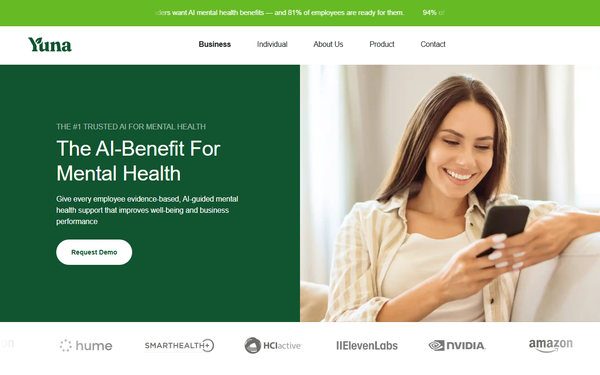
Yuna is an AI-powered mental health coach app that delivers 24/7 on-demand support through evidence-based conversations, mood tracking, and calming techniques rooted in cognitive behavioral therapy (CBT) and dialectical behavior therapy (DBT) principles. It helps users ease anxiety, reframe negative thoughts, build resilience, track emotional patterns, and access immediate guidance without scheduling or waitlists. Primary use cases include daily emotional check-ins, stress relief during high-anxiety moments (e.g., work pressure or sleepless nights), guided skill-building exercises, and proactive escalation to crisis resources when needed. It positions itself explicitly as a coaching and self-help tool, not a replacement for professional therapy.
The target audience is primarily everyday individuals seeking affordable, private mental health support—such as busy professionals, students, or anyone facing mild-to-moderate stress, overthinking, or anxiety who prefers a digital, stigma-free option over traditional in-person therapy. It also serves enterprises through workplace integrations for employee wellness (HR dashboards, aggregated sentiment insights), making it relevant for organizations, brokers, and health plans. It is not aimed at developers, marketers, or designers specifically, but at anyone wanting accessible emotional wellness tools.
Key Features & Capabilities
Core functionality revolves around real-time voice-to-voice (or text) conversations where users share how they feel, choose “support” or “active coaching,” and receive personalized, empathetic responses. Additional capabilities include mood tracking with progress insights, guided exercises (breathing, mindfulness, thought reframing), a wellness feed with mood-based recommendations, real-time safety monitoring that detects elevated distress and offers geolocated crisis resources, and iOS Health/Calendar integration for reminders.
Standout features that differentiate Yuna from competitors (such as text-only bots like Wysa) include its voice-first design for natural, human-like dialogue, clinician-informed development (PhDs and licensed psychologists), HIPAA compliance and SOC 2 certification with end-to-end encryption, proactive smart escalations, and enterprise-scale analytics without exposing individual conversations. It also emphasizes radical transparency by clearly stating users are talking to AI, not a human.
Limitations include no clinical diagnoses or medical advice, potential for AI inaccuracies or limited contextual understanding, and the fact that it is not a substitute for licensed therapy—severe mental health conditions require professional care. Some users report occasional app glitches (abrupt session endings or weaker memory across conversations). There is no extensive free tier beyond the initial session or trial, and advanced features require a paid subscription.

User Experience
Yuna boasts a low learning curve: simply download the app, create an account (email or quick sign-up), and start talking or typing. The interface is clean, modern, and conversational, with voice interaction feeling “surprisingly human” according to App Store reviews. Navigation is intuitive via a central chat window, mood logger, and quick-access tools.
Documentation is minimal—there are no detailed public guides or video tutorials on the website beyond basic onboarding prompts inside the app. Support is handled through in-app help or email, with users generally praising the ease of getting started (“Dang this is wild… simple to use”). Overall, the experience is accessible and non-judgmental, ideal for on-the-go use.

Performance & Reliability
Conversations respond in real time with efficient AI processing, and internal studies claim measurable benefits: 71 % of users report stress reduction after just one session, plus statistically significant drops in anxiety, shame, and guilt after consistent use. The app maintains high reliability for daily check-ins and crisis redirection.
Known issues are relatively rare but include occasional technical glitches (session cutoffs, inconsistent memory of prior chats) mentioned in a small number of App Store and Reddit reviews. No widespread outages or security breaches have been reported; privacy is strong thanks to encryption and HIPAA compliance. Overall performance earns consistent 4.7/5 ratings across hundreds of reviews.
Pricing & Value
Yuna is free to download with a free first session (or short trial). Premium subscription unlocks unlimited access: pricing starts around $22–29 per month (varies slightly by platform and region), with yearly options often equivalent to $70–200 annually for better value. Enterprise plans are custom and require a demo request. In-app purchases on Apple and Google Play may show tiered weekly/monthly options as low as $8.99–$22.
The value proposition is compelling compared to traditional therapy ($150+ per session with waitlists) or other apps: 24/7 availability at a fraction of the cost, plus privacy and scalability. Users who use it regularly report transformative results without the barriers of scheduling or stigma, making it an excellent bridge or supplement for those who cannot access professional care immediately.
Practical Tutorial
No official video tutorials exist on the site, but here is a step-by-step walkthrough for a common task—managing work-related anxiety—based on the app’s documented flow (tested via public descriptions and user reports). Real example drawn from typical user scenarios.
- Download Yuna from the Apple App Store or Google Play and open the app.
- Sign up with your email (or quick Apple/Google login) and complete the brief onboarding (choose daily/weekly pace).
- Tap the large “Talk to Yuna” button (or voice icon) to start a new session.
- Share your current state: “I’m feeling anxious about an upcoming work deadline and can’t stop overthinking it.”
- When prompted, select “Active coaching” for CBT-style guidance.
- Follow the AI’s lead: It will ask reflective questions (“What evidence supports that thought?”), suggest reframing exercises, and guide a 1–2 minute breathing technique (“Let’s try a 4-7-8 breath together”).
- After the conversation, rate your mood on the built-in tracker and review the session summary for insights and progress over time.
- Set a reminder via iOS integration or simply return anytime—24/7.
For the free first session, no payment is required. Full access requires the premium subscription. Official download links are available at https://www.yuna.io/individual or directly in the app stores.
Final Verdict
9/10 (or 4.5/5 stars). Yuna excels as an accessible, private, and surprisingly effective daily mental health companion for mild-to-moderate stress, anxiety, and emotional self-improvement. Individuals who want affordable 24/7 support without committing to therapy sessions or who prefer voice interaction should use it—especially busy professionals or those avoiding stigma. Avoid it if you have severe clinical conditions, need formal diagnosis/treatment, or prefer exclusively human therapists, as it is coaching only and may not handle complex trauma deeply.
One-sentence recommendation: If you’re ready for proactive, judgment-free emotional support at a fraction of therapy’s cost, download Yuna today—it’s like having a compassionate coach in your pocket 24/7.